
Memories on Memorial Day- Some Old Time Values
As I brush the old dead grass off of the base of his gravestone, and place the fresh flowers beside it, I am reminded, on this Memorial Day, of my step-father, William (Willie) Atteberry.
He is not an official entry on my genealogy family tree, but somehow it feels like he should be.
He was not a veteran, but he was a patriotic citizen who loved his country, and helped preserve it.
I treasure him because of what he did for my mother, for her kids (including me), for her grandkids (our children), and simply for the uniquely fine human being that he was.
I highly suspect that his character and many of his values were a reflection of the era in which he lived, but I’m just biased enough to think that, this notwithstanding, he was something special.
I’ve decided to reprint the eulogy I wrote for Willie when he died, so maybe you can see what I mean.
_________________________
William Edgar Atteberry 1895-1992 — A husband, a father, a father-in-law, a stepfather, a grandfather, a relative, a friend. What was it that made him so special — a genuine article — a one of a kind?
And how do you measure the influence a man like this has had on others in his lifetime, and the nature of his lasting influence.
In years, decades, even centuries to come a little girl or boy — descendants of Willie Atteberry or others who knew him well — will sit on their mother’s or father’s lap and hear about how important it is to be honest, to tell the truth, make your word good, to treat others as you want to be treated, and to pay your debts on time.
They will be told that on a job, you should always get there early and give an honest days work. They will hear about the value of good black soil, the good things about farming, and how a young man named Willie who came to central Illinois with 35¢ in his pocket went on to become a successful farmer.
They will hear how important it is to conserve resources — to tile and plant fields well so the soil won’t wash away, and to plant trees so future generations can enjoy them. And yes, they will hear the philosophy that if you earn a nickel you should save at least 4¢.
They will hear about the importance of minding your own business, treating others fairly, but not letting anyone push you around. They will learn the virtues of good country food, horses, and cow’s milk. They will hear that a good life is being generous, and helping those in need.
They may even hear a simple, inspiring story about how a small boy, with no mother and limited support from his father, ran away from an uncaring relative’s home at the age of 7 years and made it on his own by being honest, living a clean life, and by putting in a lifetime of hard work.
William Atteberry — educated, but with no formal education beyond the early grades. A man who claimed that without education a person “doesn’t have any more chance than a one-legged man in a rump kicking contest” — but a man who had a Ph.D. degree, with highest honors, in common sense.
William Atteberry — a model of simple everyday application of religious principles, an inspiration to those around him, and a solid person you could always count on.
William Atteberry — independent, strong minded, but one who knew who he was, what he stood for, and who was successful in the finest sense of the word. He often said that, living on the “poor farm,” he might have to “get a tin bill and pick with the chickens.” You never had to, Willie, and you never will.
Phares O’Daffer, October, 1992
A Witty Elderly Ancestor With A Sense of Humor

My 97 year old mother, Ruby, who was living in the Meadows Nursing Home in Central Illinois for the last 10 years of her life, had a very weak body but a sharp mind — and you never knew what she was going to say.
She was a living testimony to the fact that some people don’t lose their wittiness or sense of humor just because they get old.
Some Ruby Stories
I had been in her room a while — working on her favorite clock that wouldn’t even run a mite.
I thought she was a bit subdued, but maybe she was just worried that her designated clock fixer just didn’t have it.
“Well, I’ve fixed your clock,” I finally said proudly. “That’ll be $10, please.” “Charge it!” she shot back, without skipping a beat.
______
“Oh, that’s way too much,” Ruby exclaimed with conviction when I plopped the medium chocolate malt down on her bed stand. “I couldn’t possibly drink all that.”
Then, 10 minutes later, I heard that loud “slurpppp” that can only be caused by someone sucking on a straw, hoping against hope to get just a little more good stuff from the bottom of the container.
Then, looking up with a large smile, Ruby deadpanned, “Well how on earth did that happen?”
______
“I need a haircut today,” said Ruby, who adamantly refused to use the hair dresser services at the nursing home.
And I, her only son — with a very limited skill set — was her choice as cutter. Probably only because of proximity.
She was not at all worried that I couldn’t give her the needed thinning, so I proceeded to “snip, snip, snip,” as I whittled her mop of hair down to size.
“Okay, I’m finished cutting your hair. You look like a million dollars,” I said.
“Without the zeros,” she quipped with that wry smile.
______
Ruby had few psychological hangups, but adjusting to new eye glasses was one of her downfalls.
It happened more than once. A trip to the optometrist, a test, quite a time choosing frames, and finally, trying on the the new glasses.
“I can’t see out of these glasses,” she said, as she put them on her table and put the old ones back on.
“Just try them, Mom, you have to wear new glasses for a while to get used to them,” I replied.
After half-heartedly trying for a few days, she pronounced, “They don’t work. I don’t see right.”
“You couldn’t see with the old ones when you were getting your eyes tested,” I said. “What do you say to explain that?”
“I say that some things just can’t be explained,” she responded with a voice of finality. And that was that.
______
“So you took Dana (our grandkid, her greatgrandkid) to the dinosaur display at the museum, huh?” Ruby asked. “How did it go?”
“She really enjoyed it,” I said. “It was a wonderful display, and the dinosaurs were so amazingly realistic.”
“So how would you know about realistic dinosaurs?” she asked with a twinkle in her eye. “Just how many real dinosaurs have you seen in your life?”
______
I asked Ruby what she wanted for her 97th birthday, which was fast approaching.
“I would like to have some bacon,” she asserted without a second thought.
Her cholesterol was approaching 200, and she hadn’t been allowed to eat bacon. But she was going to be 97 years old, and that should count for something.
“Bacon it is, then,” I said.
We brought in a cake and used the kitchen to cook some bacon.
When Ruby had eaten more bacon that one would think possible, it was time for dessert.
“Do you want some cake, Mom?” I asked. “It looks pretty good.”
Ruby looked at the cake, looked as my wife Harriet and I, smiled, and said, “Well, if I have to make a choice, you take the cake — I’ll take the extra bacon.”
_______
“The doctor. is coming to see you today,” I said. “Think of some questions you want to ask him.”
“Okay, my arthritic hands are causing me a lot of problems,” Ruby answered with obvious concern. “The fingers bend both ways and way back.”
“Well, maybe the doctor can give you some help on that,” I said.
“He’d better,” Ruby responded decisively, “If he says it’s just old age and nothing can be done, we may have to get an older doctor.”
______
I walked in her room on December 22, 1999. The idea of my computer being Y-2K compatible (being able to not get all screwed up when the year changed from 1999 to 2000) was on my mind.
“You’ve got a problem,” I said, as I looked her in the eye.
She knew I was setting something up.
“What do you mean, I’ve got a problem?” She frowned, as if to say that if she had a problem, she’d know it.
“You’re not Y-2K Compatible,” I said.
“What do you mean by that?” she asked. I explained the Y-2K compatible idea, and she allowed she had seen things about it on TV.
“Why do you say I’m not Y-2K compatible?” she asked.
“It’s like this,” I said with feigned seriousness. “If you die after the end of the year, your gravestone will be all screwed up. Etched in stone, it now reads ‘Ruby Odaffer, 1902 – 19 – – .’ But then it should read 1902 – 2000. What are you going to do with the ’19’ ? ”
“Well,” she said with an air of finality and a bit of smugness for getting the last word. “ I’ve got worse problems than that. Furthermore, the way I figure it, it’s more your problem than mine.”
Postscript
My mother died on January 4, 2000, shortly after our Y-2K conversation.
She was absolutely right. Y-2K was my problem, not hers. It took me four months to get a new gravestone from North Carolina.
I look back fondly on these, and many other instances of my mother’s wit and good humor.
There is something beautiful about an ageless wittiness and sense of humor.
Looking For Clues
When I was a kid, we used to go tromping through cemeteries.
My dad, as you’ve probably figured out, is Phares O’Daffer, the “stumbleologist” who has spent a lot of his spare time in the last 58 years collecting and sharing information on our ancestors.
On family vacations or trips out east, we’d often take detours through the countryside to find old gravesites. Particularly in Ohio or Pennsylvania where some of the earliest Odaffers lived.
“Alright, everybody out of the car,” Dad would announce as he pulled our station wagon up to some tombstone grassy knoll. “Start looking for Odaffers.”
My sister Sue and I would pull our heads out of our books, put our shoes on, and gamely start tromping through the cemetery looking at each tombstone for clues to our past. It was a game for Eric, our brother, who was too little to know what we were doing. Mom went along with it because she knew how important it was to Dad.
And, like everything he does, Dad made it fun. “You’ve got 10 minutes,” he said. “Find me someone who was born in 1850. First one who does gets a milkshake.”
Come to think of it, running around a cemetery was a brilliant ploy to break up the monotony of riding in the car on a long trip. Get some exercise and tire us out so we’d stop asking, “Are we there yet?” And no matter who found what, we all got milkshakes.
Also, it was a way for Dad to involve all of us in his research into our family history. I never really appreciated that as a kid. As we grew older, none of us became interested enough in genealogy to carry on where he left off.
But I don’t think Dad ever expected that. He just wanted to pursue his passion and be able to share what he’d learned. Hence, this website.
Turns out that Dad’s first big discovery about our ancestors didn’t happen in a cemetery, but a library. The Daughters of the American Revolution Genealogy Library in Washington, D.C., to be exact.
Searching for clues in libraries on our family vacations wouldn’t have been nearly as much fun as going to cemeteries.
Genealogical Truth is Stranger than Fiction
- At March 04, 2014
- By Phares O'Daffer
- In All Posts, Genealogy
 1
1
You have probably heard the old saying, “Truth is Stranger Than Fiction.” As I have gotten involved in Genealogy, I am amazed at the truth in this timeworn adage.
No matter how hard I might try, I couldn’t come up with fiction that would come close to matching some of the genealogical facts I’ve discovered about our family.
Let me use some situations, a few perhaps mentioned before, to illustrate.
A Surprising Link to the Old World
You might think your ancestor came over to the new world on a ship of immigrants, but it is much harder to believe what I discovered in a DAR library:
- That he was a Hessian soldier who came on a British Soldier transport ship that took four months to get here
- And that he had left a family in Germany, and later stayed in the U.S to start a new family
A Soldier Who Fought on Both Sides
Who would believe that Johann Wolfgang Odoerfer would have fought for the British as a Hessian Soldier, defected, and fought for the Colonists in the same Revolutionary War?
And was given land in Ohio for his service to the Colonists? And was declared a Patriot by the DAR? You’ve got to be kidding.
A Disappearing Cemetery
Wait a minute! A cemetery with 25 gravestones here one January, and gone the next? And back the next?
Well that was a case with a small Odaffer family cemetery I discovered near Monticello, IL.
After I visited in a January snowstorm, some vandals had taken all the stones and thrown them in a nearby creek.
The local genealogists found and replaced them — making the cemetery better than before. If you hadn’t seen it, you may not have believed it!
A Prolific Great Grandfather
It did seem a little strange to find that my great grandfather David had 15 children over a span of 35 years, with two wives, who differed in age by 31 years.
I don’t think I would have written this into a book of fiction — it just seems a little too far-fetched.
The Gravestone Mystery
And there are my great great grandfather Henry Odaffer and his wife Elizabeth. Married to the end — no divorce record can be found.
Yet, Elizabeth’s gravestone sits lonely, just inside the gate of the New Tarleton Cemetery in Tarleton, Ohio. Henry’s stone is no place to be found, and there isn’t even a space for it.
In fact, I’ve looked high and low, in Maryland (in case they somehow took him back to his place of birth for burial), Ohio, and Illinois, and can find no grave/gravestone for Henry anywhere. It remains a mystery.
An Amazing Family
And who would believe that this website and my database contains information on over 1,300 Odaffer individuals and relatives — probably over 90% of the Odaffers who live or have lived in the United States?
And what an interesting group of people! Just when you think you know it all, you learn something new. I had never known of an Odaffer who was a physician.
Then, just last week, I found out that in 1942, Dr. Robert George Odaffer sold a hospital he owned in Farmington, New Mexico and bought the Cushman Ranch in Colorado to develop a tourist resort. Stuff for a novel, indeed!
So there you have it. You think what you want. But I think that in genealogy, truth is stranger than fiction — by far.
What’s in a Name?
- At February 05, 2014
- By Phares O'Daffer
- In All Posts, Genealogy
- 1
The Dilemma
Well, there it was. Right there on my birth certificate. “Odaffer.” Small “d,” no apostrophe.
I had been using “O’Daffer”– capital D and an apostrophe all my life — and my name was listed that way as an author of a whole bunch of books. And everywhere else. All of my precious — but significant only to me — award plaques said “O’Daffer.” Capital “D” and an apostrophe.
No way I could change the spelling now. But I felt I was cheating on history. If I could go back, I thought, I would darn well use “Odaffer.”
In fact, when they used Odaffer on my plumbing bill recently, I smiled and let it go — I sort of liked it.
Am I Alone?
Over the years, when I would interview a relative, the spelling of our name would often come up, and people did not always agree. Here are a couple of examples.
A Quote from a California Relative: “I can’t understand why some people have changed our name. It has always been spelled “O’Daffer” with an apostrophe and capital “D”! I just don’t like people messing with our name.”
A Quote from an Illinois Relative: “ Somebody, I don’t know who, tried to make our name Irish. Well, we’re German. It is “Odaffer” with a small d and no apostrophe. Always has been. Its just foolishness to try to change it.”
So others have had consternation about the spelling of our name. I was not alone!
What to Do About It?
In a fit of humor, I thought “WWJD?” Not quite what you thought, perhaps.
I was thinking, “What would Johann Wolfgang, my great, great, grandfather who came here from Germany do?
So I went back to Johann Wolfgang and his ancestors, to get the name straight. Johann Wolfgang Odorfer, or Odoerfer — in some records. Johann’s father — Marcus Ohdorffer. Marcus’s grandfather — Stephan Ohdorfer. And Stephan’s grandfather, way back in 1560 — Heinrich Ohdorfer.
But wait! What about the prized name “Odaffer”? Yes, I found it. Johann Wolfgang Odoerfer, like a lot of German soldiers who stayed in America, simplified his name. He used “John Odaffer.” It was his “Americanized Name,” so to speak.
But it didn’t end there. I took another peek at the 1780,1790, or 1800 census information. I guess the census takers were people that were somewhat hard of hearing, and a little lax about “getting the name right.”
The census is replete with names of Johann Wolfgang and his descendants spelled “Odeffer,” “Odoffer,” and even “Odofer.”
Looking further, I think I found that the name “O’Daffer” was first used by one of John Odaffer’s children — John B’s branch.
My guess is that one of the kids married an Irish lady, and the name Odaffer was just too close to an Irish name to pass up, so she changed to the more “stylish and Irish” spelling — “O’Daffer”
And my oldest sister Wanda, finding out that the Decatur branch of Odaffers used “O’Daffer,” could not resist the classier moniker either, and used it in High School. I followed her in school, and just fell into using “O’Daffer” because that’s the way the High School spelled it.
So it seems that there is, and always has been, confusion about the spelling of this reasonably interesting name. Not much anyone can do.
A Final Word
So there you have it. With all the changes in spelling through the years, no one has a claim on the “correct spelling.”
But, after Johann Wolfgang chose it as his American name, my great, great grandfather, my great grandfather, my grandfather, and my dad all used “Odaffer,” and that should have been good enough for me.
(Woops, I just noticed that someone, on my great grandfather’s death certificate, spelled his name “David O’daffer.” Small d and an apostrophe.) Oh Well…
Johann Wolfgang Odaffer IS a Patriot
- At December 28, 2013
- By Kay Odaffer Smith
- In All Posts, Genealogy, Guest Posts
- 0
After outlining my own interest in family history and in becoming eligible to join the Daughters of the American Revolution, I will now relate the often frustrating process of getting Johann Wolfgang Odaffer declared a Patriot.
My Initial Difficulties
In assembling my initial DAR application, I only had partial information and the application was returned with many questions.
The DAR National Society Genealogist concluded: “It remains to be proven whether John Odoffer of Maryland is the man who performed service in Virginia. A conclusion cannot be reached based upon the evidence provided.”
Our problem was complicated by the fact that the American Genealogical-Biographical Index (AGBI) references a John Odoffer born in 1740 in Virginia. The citation for this information is the book Virginians in the Revolution by John Hastings Gwathmey.
However, the Gwathmey book does not in fact contain a birth date or place of birth for John Odoffer. I have learned it is common practice to assume soldiers were natives of the state in whose army they fought.
The application also was rejected because I had not noted the information Phares O’Daffer had developed concerning Johann Wolfgang’s marriage in Germany and the two children from that marriage. That should have been included to support his service as a Hessian.
There were numerous other discrepancies cited, generally having to do with the typical inaccuracies which occur when census forms were completed in the earliest days of our country.
One of the most notable difficulties came from the fact that John Odaffer had been given a land grant by the Virginia House of Burgesses, but we had no information about what happened with that grant. Omitting any mention of a search for land records was not helpful to my cause.
The Impossible Takes a Little Time
At any rate, the first rejection made me more determined than ever.
Phares was most helpful with the additional documentation he had, copies of documents and church records were received from the Clear Spring, Maryland area, and a trip to the Newberry Library in Chicago was most helpful.
I was able to get actual copies of all of the books I needed in which John Odaffer was mentioned and photocopy relevant pages.
I reassembled my material, wrote a rebuttal and sent the package back to Washington, all to no avail. The genealogist there was still stuck on the fact that my ancestor seemed to be from Virginia, lived in Maryland, and married a woman in Pennsylvania.
What a muddle! I learned subsequently that differences such as this automatically throw up a red flag when the national genealogists begin to check applications, presumably because people were not as mobile then as now. They can be explained, but cannot simply be left without further notation.
Nothing Helps Like Good Help
A good friend who was Regent of the Sgt. Caleb Hopkins Chapter, DAR, put me in touch with the Illinois State Membership Chair, who had a great deal of experience resolving “sticky” issues such as mine had become.
She took on the task of filling in the missing information by contacting “volunteer genealogists” which nearly every DAR chapter has. These kind ladies in Ohio and Maryland searched local land records and concluded the grant must have been sold since there was never property registered in the name of Odaffer.
Having made the search was enough for the national genealogist. Also, the volunteers pieced together the history of the family’s migration from Maryland to Ohio and made logical conclusions that led to a favorable result.
It Took a Lot of Documentation
Documents used were the Estate Distribution dated March 1816 from Washington County, Maryland, naming the heirs of John (presumably his children).
Also used were the 1810 Census showing John and wife, aged over 45, with eight children, the 1850 Census showing Henry and Elizabeth (ages transposed) with their children in Clear Creek, Fairfield County, Ohio, and the 1860 Census when Henry was living as a member of son David’s household in Pickaway, Pickaway County, Ohio.
All of this is tied back with the 1910 Census in Jacksonville, Morgan County, Illinois, where David lists the birthplace of his parents.
Also used was an excerpt from the “German-American Genealogical Research Monographs #2,” by Smith, published in 1974, p. 43, where Johann Wolfgang is reported as a deserter in Ansbach, Germany who had been conscripted to serve as a mercenary. Also, his family history was verified using a German Parish Register in Ansbach.
Success!
When the application was submitted with all of this information and supporting documentation, Johann Wolfgang Odaffer was declared to be Patriot #206566 in recognition of his support of the War for American Independence.
And I was accepted as a Daughter of the American Revolution! It was all worth it.
My Evolving Interest in Family History (and the DAR)
- At December 26, 2013
- By Kay Odaffer Smith
- In All Posts, Genealogy, Guest Posts
- 0
Greetings! My name is Jeanne Kay Odaffer Smith and I will be posting about my interest in Odaffer family history and the process I subsequently went through to have one of our ancestors, Johann Wolfgang Odaffer (Odoerffer), declared a Patriot and listed as such by the Daughters of the American Revolution. But first a bit of background and my reason for putting the effort into this declaration.
My Background and Our Early Odaffer World
I was born in Jacksonville, Morgan County, Illinois in 1945. My father, Harold Odaffer, has five brothers and sisters and they were the only Odaffers we knew about, except my grandfather Ray Odaffer’s two brothers, neither of whom had children.
My father had been in the Coast Guard during World War II and stationed in New York and Rhode Island. While there and when we took the Great American Road Trips to see the West in the 1950s, he always searched telephone books for Odaffers but found none. There was speculation that the family was Pennsylvania Dutch or even possibly Norwegian.
One of my uncles, George Odaffer, married a German woman and brought her home with him. She knew of people in Germany named something that sounded like Odaffer but wasn’t spelled exactly the same – maybe Oderffer. That was all we knew.
Our Odaffer World Expands
In about 1975 the “Odaffer” world began to open up for me when our daughter came home from one of the early primary grades with a mathematics textbook written by Phares O’Daffer. How shocking! While not spelled correctly (wink, wink), this was my first clue that we were not the only Odaffers on the planet.
Several years later my husband and I attended a performance of the Springfield, Illinois, Symphony which was performed in Bloomington, Illinois. In the program was noted the financial support of Mr. and Mrs. Phares O’Daffer. Aha! He doesn’t live too far away…but I left it at that.
A few years later, possibly sometime in the late 1980s, one of my Odaffer aunts was contacted by Phares and asked for information about our branch of the family. He told her the family background and left a lengthy document with her.
I must say there was a lot of skepticism. A Hessian who fought against us in the Revolution? Come on.
And there was also, strangely, some fear of the unknown. Some, including my father, now had no interest in learning the history of the family, suggesting that perhaps there were some deep dark secrets that perhaps we didn’t want revealed.
Phares’s documentation was the first we, the Morgan County Odaffers, learned of the O’Daffers living just a bit to the east of us in Piatt County, Illinois. And (here’s the deep dark secret) my great grandfather was married before and left a woman and several children when he divorced her and moved to Western Illinois.
There he had married my great grandmother and fathered three sons. I wasn’t even sure “regular” folks got divorces back then but apparently they did!
My Quest to be a Daughter of the American Revolution Begins
I had neither the time nor ability to do any further research but simply accepted Phares’s good work. However, when I retired and realized a lot of my friends from other organizations in Springfield, where we were living, were also members of the Daughters of the American Revolution, I became curious about what I would need to do to be able to join.
Would they even accept the descendant of a Hessian Turncoat?
After a brief conversation with the Registrar of the Sgt. Caleb Hopkins Chapter, located in Springfield, I was told that it didn’t matter how my ancestor began the war; it was only important on which side he was at the end. Well okay then!
I had no trouble with records of births, marriages and deaths occurring in Morgan County. This took me back through my great grandparents, the aforementioned David and Julia Frazier Odaffer, my great grandparents.
Of course newspaper clippings are often useful as supporting proofs for genealogy, and in the obituary of David Odaffer I discovered a shocking fact – the existence of his first wife and the children by that marriage were mentioned in David’s obituary when he died in 1918.
My grandfather, Ray, was 28 years old in 1918, literate, and certainly knew of the existence of his step- brothers and sisters, but chose never to tell his own children about them.
After all of that discussion about where we came from, he didn’t say a word. He was a bit hard of hearing but not that deaf! It must have been something that embarrassed him and he stayed mum, leaving the rest of us to wonder and search.
I’ll blog soon about my quest to have the DAR acknowledge Johann Wolfgang Odaffer as a Patriot – a long and frustrating, although ultimately successful process.
4 Tips for Better Genealogy
- At November 30, 2013
- By Phares O'Daffer
- In All Posts, Genealogy
- 1
Whether you are just starting, or are an accomplished genealogist, I would like your reaction to these four tips for better genealogy.
Applying these tips, even more than I did, would probably have helped me in my quest to find out about the Odaffer family. Each tip is illustrated by where I used it and how it helped.
Tip 1 — Leave No Stone Unturned
I’m amazed that my 16-year-old son Eric agreed to go on a genealogy trip with me, and how well he resisted the inborn need a 16 year old has to rebel against adult imposed endeavors — except maybe at the very end of our trip.
Looking for signs of my great grandfather, David Odaffer, we ended up in an old cemetery near Circleville, Ohio. Our well had run dry — no Odoerfer or Odaffer graves to be found. It was time to go home.
It was then that I spied a pile of old stones, out in a back corner of the cemetery.
“Come on,” implored Eric. “You’re not going to find anything back there. Let’s get out of here.” I finally got Eric to help look through the pile of stones. On the bottom of the pile — literally the last stone — we found a dirty, barely legible piece of a broken gravestone.
We brushed it off, and with great excitement read “Ida May, daughter of D. and A. Odaffer, Died April 2, 1861. Aged 1 yr, 9 mo, 2 days.” We had located David in Ohio!
I gave Eric a short speech on the value of thoroughness and persistence in genealogy, as well as in life — a lesson I’m sure he really only learned by himself when he got older.
Tip 2 — Call or Write Often
Over the years, whenever I was in a different city, I checked the phone book, sometimes finding an Odaffer, and gave them a call.
I had to work hard not to get hung up on, but it usually worked out. And I often found out something new about the branches of the Odaffer family.
And I have written many letters to county clerks, church officials — you name it. Sometimes it paid off too.
On a trip, I had stopped at the Church of the Latter Day Saints Genealogy Library in Salt Lake City, and was about ready to leave when someone on the staff told me that he would help me prepare a letter in German.
With his help, I wrote letters to three Lutheran churches in the area near Nuremberg, Germany, where I suspected some of Johann Wolfgang’s relatives might have lived.
Amazingly, I soon received a letter from Georg Odoerfer, a member of one of the churches, who became a contact in Germany and a good friend.
Georg gave me a lot of help, often translating from books written on Old (High) German, to gather information about the Odoerfer family.
There is no doubt that making the right calls and writing the right letters can really be helpful in finding out about your family.
Tip 3 — Don’t Believe all You Hear
I talked to an older relative in our family about my great grandfather David Odaffer. She was old enough to have known David, and was a really valuable source as I delved into his life. Or so I thought.
She told me, “David came from a wealthy family in Ohio, and migrated to Illinois with $1000 sewn into his shirt. His wife Amanda wanted him to buy a farm near Monticello, Illinois, but he fooled all of his money away on drink.”
Upon checking this out, I found that there is plenty of evidence that the “wealthy family” label wasn’t accurate, and an abstract in the County Court House in Monticello showed that David bought 69 acres of land — soon after he got here — from John Dove for $1,360.
So you have to verify — check and recheck — the verbal information you receive. Sometimes people make the stories be the way they wanted them to be, not always reflecting the truth. The relative didn’t like David, and that may have colored her story.
Tip 4 — Record, Then Record a Little More
Everybody needs an Al Field. I had been working on the Odaffer family for several years before I met Al, who, being a relative, was also researching the family.
I had collected a lot of information about the family, probably more than anyone else.
And I knew that what I reported was true, since I had gotten it from very good records and sources.
But Al shocked me by demanding documentation, and in some cases, I didn’t have it. Oh, I’d had it once, and thought I had written it down carefully. But, lo and behold, my records just weren’t complete enough. I would record some basic information, but not enough and in not enough detail.
Al simply opened my eyes to the fact that you have to have a very good recording system, and you have to religiously record, and then record some more.
I got better at recording what I found, but some of the original gaps are still there, and I regret that I didn’t meet Al earlier. Thanks, Al.
So there are the four tips. Use them if they merit, and look for more hints to come!
God’s Grand Plan or Lucky Random Chance?
- At November 23, 2013
- By Phares O'Daffer
- In All Posts, Genealogy
- 0
You probably knew that a serious post would come sooner or later, so join the solemnity and consider the question, “What are we to make of our ancestor’s near brushes with death?”
I think the life of Johann Wolfgang Odoerfer, the Hessian soldier who is my (and maybe your) ancestor and link to Germany, makes us think about this question.
A Brush With Birth
Johann Wolfgang was almost not born. His father, Marcus was the 13th child in the family — an unlucky number at that. And evidence is that he almost died at birth. No Marcus, no Johann Wolfgang, no me (or maybe you).
Some Brushes With Death 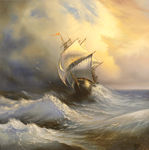
Also, Johann Wolfgang, as a soldier, had some near death experiences.
On the ship the Hessian soldiers sailed on to America, many soldiers — even one of Johann’s friends, died of malaria. Johann Wolfgang was spared.
When Johann Wolfgang was quartered in Rhode Island, the famous 22-ft. snowfall was devastating. Many soldiers froze to death, or got lost in the storm, were covered with snow, and died. Johann Wolfgang lived through this ordeal.
In the battle of Yorktown, Johann’s regiment was shelled unmercifully by their enemy, and was left to fight as the rear guard as Cornwallis attempted to escape by sea. Had Cornwallis not been compelled to return because of violent waters, Johann Wolfgang and his regiment would surely been annihilated by the overwhelming French and American forces.
Johann Wolfgang was captured in the battle of Yorktown, and forced to make a grueling march from Yorktown to Winchester Barracks prison in northern Virginia. The conditions in the prison were terrible, and a high percentage of the prisoners — not Johann, however — died of dysentery or other diseases.
A Question About Life
For sake of discussion, let’s assume that if Johann had died or been killed before he had a chance to sire Henry, his ancestors in that line would not have existed.
Pretty serious stuff, which could make those of us who are Johann Wolfgang’s descendants ask, “Am I here because Johann stayed alive by Lucky Random Chance, or because the whole scenario was a part of “God’s Grand Plan?”
This is a mysterious question, and some of the events related above and others — such as the violent waters that forced Cornwallis’s return to the battle of Yorktown — suggest to some that more than chance has to be at play here. But each of us has his/her own ideas about the bigger question, and we will probably never be able to prove that our ideas are correct.
The Bottom Line
But one thing we can hang our hats on is that Johann Wolfgang Odoerfer was one in a long line of courageous ancestors — with their warts and all — who gave all they had in their own way to pave the way for their descendants who followed them.
I guess that’s about all anyone can do, hopefully with God’s help.
10 Geneology Taglines and Tales
- At November 09, 2013
- By Phares O'Daffer
- In All Posts, Genealogy
- 1
Yes, there is humor to be found in genealogy. The 10 tantalizing taglines below can be found in various places, with no indication of who first said them. So I apologize for not being able to give credit to the originators, but thank them for glimpsing humor in genealogy and passing it on.
Enjoy the taglines, and the little tale, or observation about genealogy that comes with each one.
Tagline 1: Genealogy research — what I’m doing when I don’t know what I’m doing.
 I have alluded to the possibility that I am a “stumbleologist” rather than a “genealogist.” Often, I have just searched and searched and finally stumbled onto something good. Like just happening to talk to an old guy in a library in Clear Spring, MD, who told my son Eric and I that John Odoerfer worked on the nearby John Mason Farms (Montpelier Estate, right), opening up a wealth of information about our ancestor.
Tagline 2: To a genealogist, everything is relative.
 What a treasure trove of information you can get from talking to a relative. When I first started looking for my family tree, it was the photos, letters, and newspaper clippings in my Aunt Grace’s attic, along with her memories, that got me started. I did get a little suspicious, however, when Aunt Grace (left) told me that my great grandfather David had blond hair and blue eyes, given that all the other Odaffers I knew were black hair and brown eyed wonders.
Tagline 3: So many relatives, so little time.
The Odaffer family tree in this website contains over 1,200 relatives. And I am sure that just scratches the surface — thousands more in Germany, way back. And there are probably many more, uncharted in the United States. It is a work in progress – like a significant mountain, you just climb it because it is there.
Tagline 4: Genealogy — chasing your own tale.
Sure, a genealogist really wonders how he or she got here. There is a story out there, and all the details of the story will never be found. Now it is a short tale, but gradually getting longer. It is a bushy tale, with lots of strands. Ah, the satisfaction of grooming that tale!
Tagline 5: Cemetery — a marble orchard not to be taken for granite.
 Genealogists spend a lot of time in cemeteries, and even looking for cemeteries. After searching a while, I went out on a blustery, cold winter day to find an old, forgotten country cemetery near Monticello, IL (right), that had a lot of my relatives buried in it. Too cold to be doing it at all, I photographed the stones, and recorded the names.
Two years later, I returned to re-look at that cemetery. It was totally gone! Luckily, people who cared found the stones, vandalized, down by and in a nearby creek, and restored the cemetery as best they could.
Tagline 6: That’s strange; half my ancestors are women.
We sometimes, unfortunately, forget that it takes two, a man and a woman, to produce a descendant. So it is not strange at all that half of my ancestors are women. But largely because of strange traditions and biases, as well as simply the ease of doing it because the male name doesn’t usually get changed, it is conventional to pay more attention to the male ancestors than to the women. But I am also working on my mother’s side of the family.
Tagline 7: Every family tree has some sap in it.
When my great grandfather David left his wife of many years to marry a much younger woman, I though a bit of a sap had been found. However, as often is the case, there were two sides to the story, which muddied his candidacy for being a sap. However, there are always plenty of saps to go around in a family tree.
Tagline 8: Genealogists never lose their jobs; they just go to another branch.
I was pretty self satisfied with my classification of the Odaffers: the Illinois Branch, the Indiana Branch, the Minnesota Branch, and the Kansas Branch. I had determined that the original Odaffers in Ohio had all migrated westward to form these Branches. It wasn’t until a friend, Stan Clemens, sent me a newspaper article about Whitey Odaffer in Lima, Ohio, that I discovered a currently existing Ohio Branch, and went to work on it.
Tagline 9: My ancestors are hiding in a witness protection program.
I have tried to find out what happened to Maria Magdalena, Johann Wolfgang’s wife from Germany. No matter how hard I try, I can’t find a record of her death, nor the place where she was buried. I have contacted the church she probably attended, and they can find nothing. If I didn’t have her birth record from the church, I would wonder if she ever existed. Witness protection program, indeed!
Tagline 10: Genealogists live in the past lane.
No doubt about it. I have spent a lot of time since 1955 thinking about the past. From a search for ancestors living in Germany in 1560 to a search to solve some cold cases still open today, it has been an exciting journey — and always in the “past lane.”