
One Guy’s Caregiver Experience

Recently I received a call from a caregiver group at our church. Since I had just ended a 13-year stint as caregiver for my wife Harriet who had Alzheimer’s, they asked me to talk to them about my experiences as a caregiver.
In the fall of 2007, my family and I noticed that Harriet, always attentive to details, was exhibiting an unusual amount of forgetfulness. She was soon diagnosed as having mild cognitive impairment.
Her neurologist told me that the mild cognitive impairment might or might not progress into Alzheimer’s. Only time would tell.
His prescribed drugs, Aricept and Namenda, were not curative and would only possibly slow the possible progression.
I’m not sure about slowing, because 13 years later Harriet had progressed through five of the five stages of Alzheimers, and died after a fall fractured her hip.
My Reservations
I delayed agreeing to talk to the caregiver group because I didn’t want to portray myself as some sort of expert.
The truth is that I probably know less about caregiving for Alzheimer’s than most because I relied primarily on just being there and seeing what was happening to discover effective ways to cope and deal with Harriet’s terrible situation.
But, I finally decided that I might have something to say that could help people cope with caring for someone with Alzheimer’s. So the following is an adaptation of what I said to the group.
The Terrible Progression of Alzheimer’s
According to a Mayo Clinic reference, Alzheimer’s Disease goes through five stages, progressing from only scientific detectable changes in the brain, through mild changes in memory/thinking ability, then through greater difficulty in completing/remembering complex tasks or ideas.
In the last two stages, the person shows significant changes in personality and behavior and needs total dependence upon others for personal care and existence.
The Brutal Truth About Alzheimer’s
As I began to understand what was happening to Harriet, I accepted the following two truisms, and they helped me clarify my task as a caregiver.
Truism 1: People with Alzheimer’s, especially in later stages, don’t do most of what they do on purpose, and generally can’t control their actions.
Now, before reading the second truism, think of the long list of all the normal things a person can do just prior to being diagnosed with the disease.
Truism 2: People with Alzheimer’s will probably not be able to do hardly any of these things at the end when the disease has run its course.
And you never really know in advance when they won’t be able to do something today that they were able to do yesterday. You, as caregiver, are a facilitator of transitions through the stages.
How Did I Want to Be As a Caregiver?
Remembering that “You can’t control what happens, but you can control how you react to it,” and knowing that I wanted Harriet’s terrible progression through the disease to be as kind, loving, and meaningful as possible, I decided to take the following vows.
Much like my marriage vows, they totally shaped my approach and attitude toward being Harriet’s caregiver.
Also, I decided early on that when something humorous came up, I would not feel guilty laughing about it. I always felt I was not laughing at Harriet, but rather laughing as a sort of rebellion against the horrible disease.
And I also felt it was much better in the situation to laugh than to cry. So if any of my incidents illustrating a vow strike a chord of humor in you, feel free to join me in a good laugh.
My Caregiver Vows
- I will always treat Harriet with Unwavering Kindness
Very early on in her disease, Harriet drove us to Walmart. I asked her to wait at the front while I went to buy something. When I returned, Harriet, and our car, were gone. She had driven home without me. I tested my first vow that day.
- I will always treat Harriet with Loving Acceptance
As I tried to get Harriet once to help me find her lost hearing aids, I noticed that she was vigorously chewing away on something. You guessed it, the hearing aid! This second vow kept me from lecturing her that chewing up your hearing aids is a no-no.
- I will always treat Harriet with Infinite Patience
At the dinner table in our senior living community, Harriet started taking her neighbors utensils and sometimes their food. I would carefully explain to her why she shouldn’t do this, and give them back, only to have her take them again, and again. Finally, finding a workable diversion solved the problem, and reinforced how much patience I was going to need.
- I will always foster Co-Decision Making when caring for Harriet
Rita, Harriet’s other caregiver, once bought Harriet a red top that looked like a common red handkerchief. Realizing it didn’t fit Harriet’s style, Rita decided to return it. The next day, Harriet turned to me, totally out of the blue, and said “I really like my new red top.” Needless to say, she wore that top the rest of her life.
- I will always try to Give Total Attention when helping Harriet
In the last stages of her disease, it got difficult getting Harriet to eat and drink enough. I can remember working with her for 20 extra minutes, just to get her to finish a glass of water or juice. You simply needed to “stick with it” and pull out all the stops so she would get nourishment and not get dehydrated.
6. I will always try to find ways to Welcome Laughter into Harriet’s care
Near the end of her life, I was feeding Harriet some amber colored chicken noodle soup when the TV tray got bumped and the soup spilled on my pants. Looking at the soup color and where it spilled on my pants, we both started laughing and got “too tickled to stop.” I really cherished that kind of laughter.
Digging a Little Deeper Into a Caregiver’s Role
Beyond being deliberate about my attitudes, some other things I found really important in caring for Harriet are listed below with illustrations.
Other Helpful Things a Caregiver Can Do
- Establish Consistent Patterns in daily activities
Harriet’s pattern for bedtime was: start at 8:30 pm, put on bedclothes, stop for a hug (tell her she is the best hugger in the world), put her in bed, and say a prayer (naming family and friends and affirming God’s love for her). I think this pattern was one reason why she was such a good sleeper.
- Keep Them Involved as long as possible
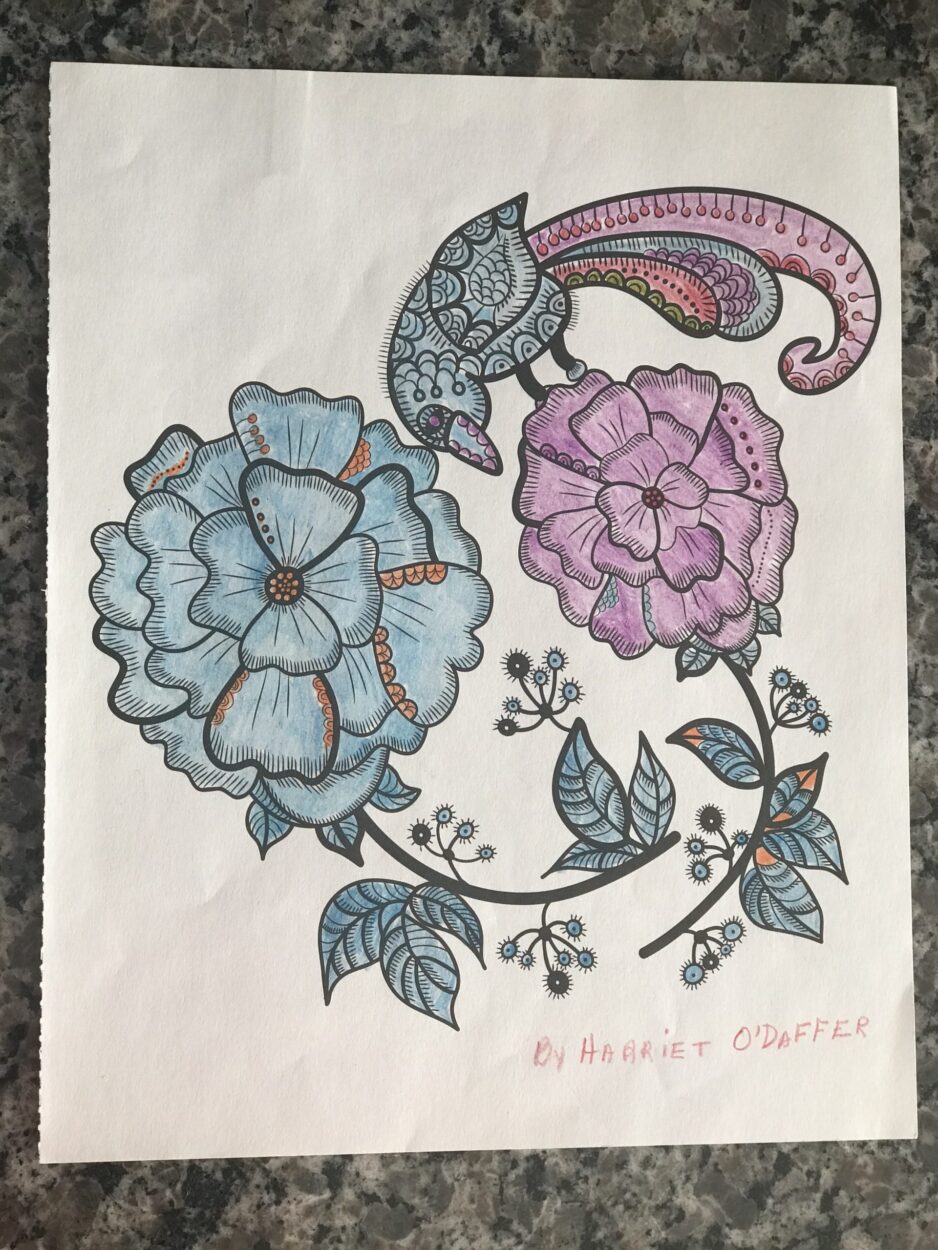
Harriet loved coloring, golf, driving the car, bridge, choir, crossword puzzles, reading, listening to music, poems, and watching sports. My goal was to keep her doing these things as long as she could do them. The following picture she colored halfway through her Alzheimer’s journey illustrates this.
(Click on the picture to see Harriet’s signature. Click the arrow in the upper left of the screen to return.)
3. Find Their Key and integrate it into their daily activities
Harriet’s key was music. One evening Harriet and I were sitting on the couch and I was running through the TV channels. I came to Pink concert and was focused on going right past it when I saw Harriet slapping her leg to the beat. Needless to say, Harriet and Pink really enjoyed the next half hour.
- Facilitate Their Transitions as smoothly as possible
Harriet always waited patiently outside the bathroom at the ISU basketball games while I finished inside. One night, as I started going out, Harriet started coming in. She was met by men, telling her in no uncertain terms, “Lady, you can’t come in here.” Clearly, another transition was upon us.
- Keep Them Connected to their past
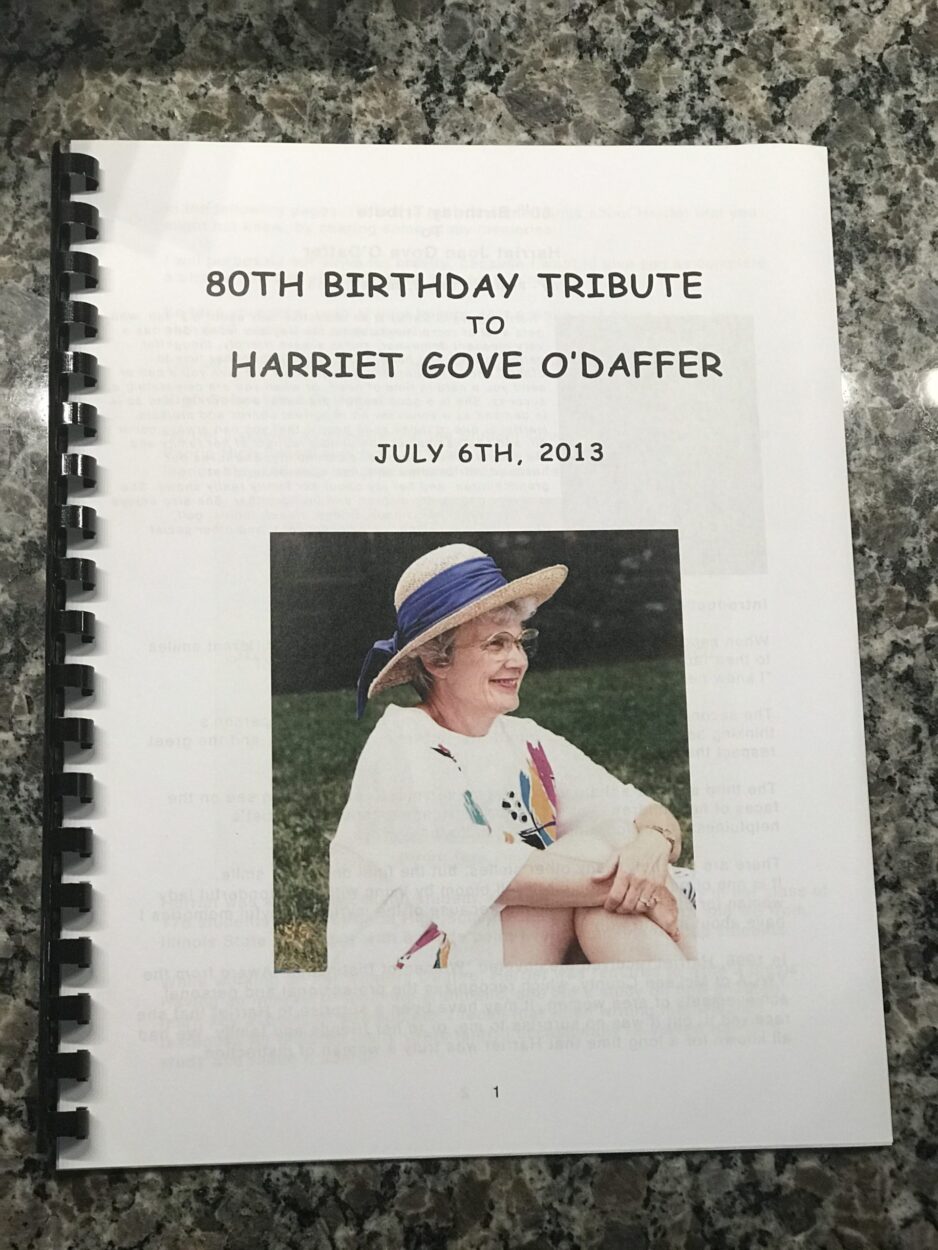
I wrote this 23 page tribute to Harriet when she was halfway through her Alzheimer’s experience. I wanted her to be able to remember her past, and I wanted her kids and grandkids to remember her like she was pre-Alzheimer’s. Harriet looked at the booklet a lot with her family. I think she was proud of it.
Some Final Thoughts About Being a Caregiver
People always tell caregivers to “take care of themselves,” and that is certainly true. I totally bought into this, and looked for ways maintain some sensibility and balance in my life throughout the whole process. Here is what worked for me.
How to Keep Your Caregiver Sanity
- Make time for Yourself
Having Rita to help with Harriet for several hours each week was so valuable, for Harriet, Rita, me, and others. It certainly helped my golf game and my fun at the library. When my son Eric came on several occasions to stay with Harriet for a few days while I went places with my daughters, Rita helped him with certain things. Eric called her “Rita from Heaven.”
- Accept Help in Decision Making
From “When should we go to a retirement community?” to “Is it time for hospice?,” there are many decisions to be made. I was blessed to have a great relationship with three wise and wonderful adult children (Sue, Sara, and Eric) who fully participated in all those major decisions. It really helped.
3. Keep a Sense of Humor
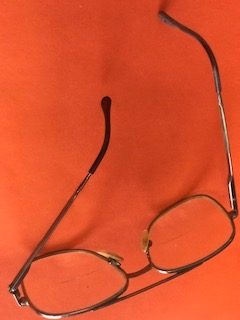
As I picked Harriet up from a History Club meeting once at Al and Linda Bowman’s house, instead of her cute purple frame glasses, she had on a pair of larger, manly glasses. Al’s glasses? A large club–woman’s glasses? Nope. Mystery unsolved! Harriet and I had a good laugh. And I still have the glasses.
- Take Things in Stride
From asking Harriet to go in the bathroom and take off her hose for a pedicure and having her come out with both hose and pants off, to having her leave the car and go into a store while I was busy pumping gas, we all learned the importance of “taking things in stride” and “not sweating the small stuff.”
5. Treasure the Little Things
One time, Harriet, who was hurrying across the room, saw me on the couch, broke stride, came over to me, smiled, and pulled my big toe. Other times, in the same situation, she smiled, patted my leg, or gave me a “thumbs up.” I was always on the lookout for little things, like her saying, “He’s my husband.” That made all the difference for me.
6. Honor Your Loved One
Once my caregiver life was over, it was great therapy for me to honor Harriet for the things she put up with during her long bout with Alzheimer’s. I make a collage of pictures on one of my walls, accompanied by a tribute to Harriet. It gave me the final closure that all caregivers of loved ones must have.
A Tribute to Harriet, by Phares

Harriet, my special lady, died on September 27, 2020, after a 13 year battle with Alzheimer’s disease.
The photo above on the left is representative of her vibrant years as a wife, mother, teacher, friend, and amazing community volunteer –a liver and lover of life, and an acceptor of responsibility. It dramatically reminds me of her unwavering spirit of love, friendliness, helpfulness, cooperation, and love of adventure.
I can tell you for sure that she was, as she appears, a real winner — a truly wonderful woman.
The photo above on the right was taken in her latter stages of Alzheimer’s. I love the photo because the expression on her face also tells a story. With all the awful things she had to deal with in coping with this terrible disease, Harriet’s facial expression above reminds me how she tackled the disease with dignity, even when everything was against her.
Somehow, she found a way to rarely be angry, to maintain her pleasant look, pat me on the knee or pull my toe, and often sport a full fledged smile. I always felt, even in the toughest times, she was trying to be helpful, and make things for me as easy as she could.
So join me in this tribute to Harriet. She was special all her life!
Some Concluding Comments
I would be remiss not to emphasize how much the support of family and friends helps you as a caregiver.
In addition to our kids, the spouses of our kids, our grand kids, our friends, the staff at Luther Oaks, and many of our relatives were always very attentive to Harriet’s needs. They really gave her the time of day!
For example, our daughter-in-law, Stacy wrote Harriet an interactive card every day for long periods of time. It become a ritual for Harriet and I to read them and answer Stacy’s questions.
Harriet’s brother Jack and his wife Jean wrote Harriet a letter every week, and so did Harriet’s sister Ellen. Reading those letters with Harriet helped a lot.
In fact, I see all of these people as “assistant caregivers,” and treasure all of their input, much of which I haven’t mentioned.
A Final Caveat
If you are thinking that what I’ve told you in this post is too good to be true, you are a good judge of what it means to be human.
I set high standards for how I wanted to be as a caregiver and how I wanted to help Harriet cope with the suffering caused by Alzheimer’s.
I wasn’t perfect.
Sometimes, I look back on things and wished I had handled some of them differently. I even bent a vow a little now and then to accomplish what I thought I had to do.
But I always tried as hard as I could to keep my vows, have a good attitude, and create as pleasant and loving experience for Harriet as possible. And other people did too.
I think she noticed.
Zeroing In On Zoom
I wonder what my mother Ruby, who at 97 years of age could hardly believe the reality of the Internet, would think of Zoom calls today?
“Talking to and seeing my kids and grandkids from all over the country ‘alive’ on one screen? How can this happen?” she would surely ask.
How Did Zoom Happen?
In 1994, a young Chinese man told his girlfriend, who lived 10 hours drive away, that he would someday invent a way that they could see and talk to each other or to a group of their friends, from a distance.
That young man, Eric Yuan, fresh out of college, also heard a speech by Bill Gates about the Internet that inspired him to come to the U.S. and fulfill his dream to start a teleconferencing company. After eight failed attempts to get a visa, Yuan finally got one, and the rest is history.
Yuan got backing, implemented his creative ideas, and Zoom was started in 2013, well before the onslaught of the coronavirus. Zoom has now grown to a $35 billion company, and Yuan’s personal wealth was recently listed at $16.7 billion. Quite a story from the monetary success standpoint. But let’s look at the rest of the story.
What Did (Does) Zoom Do For Us?
Since the onslaught of the coronavirus, many of us have been led, inexorably, to one Zoom meeting after another.
It almost seems that someone who has not been in a Zoom meeting is like someone who has never eaten ice cream– bordering on being an oddity.
My guess is that in this era of the coronavirus, Eric Yuan gets a great deal of personal satisfaction knowing that his creation is helping people all over the world to get together with their families, conduct business, fellowship with church and other groups, and just keep in touch — all from the cozy atmosphere of their own homes.
(To enlarge the photo, click on it. To return, click on the arrow at the top left of your computer screen.)
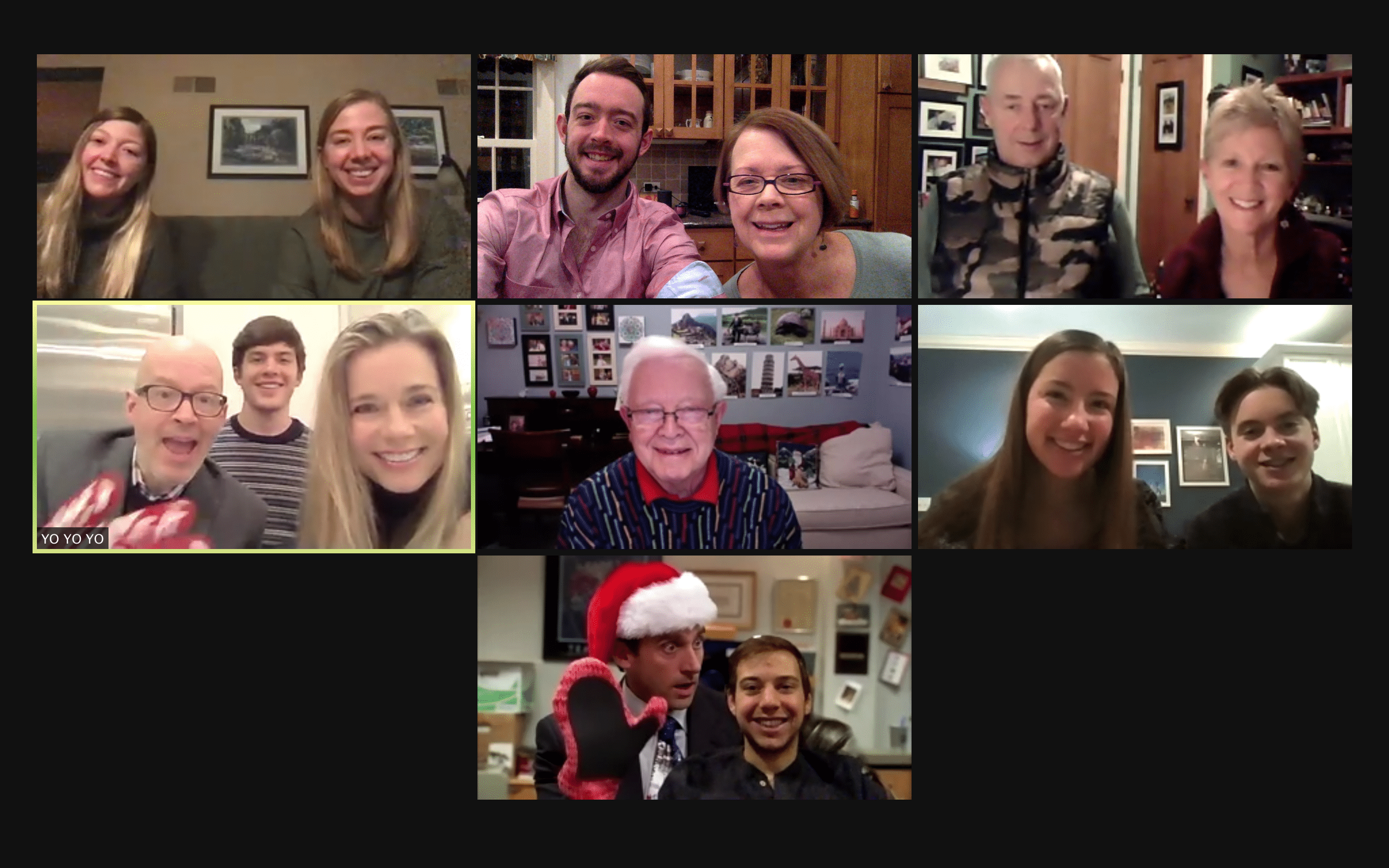
A screenshot of one of my recent family Zoom meetings.
Zoom has greatly helped us communicate with each other, maintain our psychological health, and reduce the stress of tangling with the virus. Thanks a heck of a lot, Mr. Yuan!
And, oh, I forgot. Zoom has also provided us with quite a lot of humor, on what could be pretty dreary days. Let me tell you what I mean.
Are We Zoomers Funny, or What?
So many of us are using Zoom, that it wouldn’t be far fetched to refer to us as Zoomers, or Zoomies (I prefer Zoomers).
Having been involved in several Zoom meetings, I’ve watched us Zoomers carefully, and have gotten several good laughs.
So let me tell you about the different types of Zoomers I’ve met, some of whom may be me.
The Far Sighted Zoomers: Those who sit so far from their screens that one can only guess that they are there — a small blot in the distance, causing others on the call to go for their telescopes.
The Near Sighted Zoomers: Those who sit so close to the screen that their images are distorted, like they would look if they were primping in front of a magic mirror.
The Shadow Zoomers: Those sit just the right distance away from the screen, but are perplexed because they appear to be almost in total darkness, oblivious to the idea that it would help to turn on a light.
The Half-There Zoomers: Those who slouch down in their chair so far that only the top half of their face shows on the screen. Either they are trying to remain incognito, or can’t “see themselves as others see them.”
The St.Vitus Dance Zoomers: Those who can’t sit still, always moving around on or off their chairs for no apparent reason. They, like their distant ancestor who had St. Vitus Dance, simply need to be always on the move.
The Gorging Zoomers: Those who pile on calories the whole time — always snacking during the meeting. Others wonder why they always have their meetings at this Zoomer’s mealtime.
The Mostly-Muted Zoomers: Those who never turn off their mute button until their fellow Zoomers all stare at them and cup their hands to their ears.
The Chatty Zoomers: Those who spend 80% of the meeting writing chat notes to people at the meeting, while ignoring what the meeting is all about. Sometimes these Zoomers are asked to take minutes of the meeting.
The Tardy Zoomers: Those who can never get to the meeting on time, taking an extra 10 minutes beyond the start of the meeting to find the meeting invitation and click the right place to get into the meeting. These Zoomers often ask, “What are we talking about?
The Otherwise-Involved Zoomers: Those who don’t really want to attend the meeting, and so they spend the whole time with their image blackened out, while they work out on a treadmill. These Zoomers would tell you that they are good at multi-tasking
The Loud Zoomers: Those who somehow feel that they have to shout to be heard by all those people on the Zoom call. The resulting effect is that ear plugs often have to be passed out at meetings.
The Self-Conscious Zoomers: Those who keep taking a peek at themselves to see if everything is alright with their image on the screen. Sometimes they try to disguise the peek by looking out out the corner of their eye, but it’s still a peek. The solution is to push Stop Video so no one can see you.
I’m sure you recognize some of these Zoomers and have met others I’ve failed to mention. For example, the last two categories above were suggested after this post was published by my daughters, Sue and Sara, and I felt they just had to be included. Surely we will find other recognizable types of Zoomers as time goes on, but as of now, that’s us!
So What’s The Bottom Line on Zoom?
Would you have believed, even a year ago, that people all over the country would start off 2021 spending countless hours each week in Zoom meetings?
And don’t be embarrassed if you feel a little like my mother would, scratching your head and asking, “How can this happen?”
So here we are — the Zoomers! We are getting better at the game, and will undoubtedly cull out any bad Zoom habits as time goes on.
My advice to you during this Zoom trend is “If you can’t lick it, join it (and enjoy it).” And don’t expect it to be obsolete any time soon!
My Dad’s Croquet Mallet
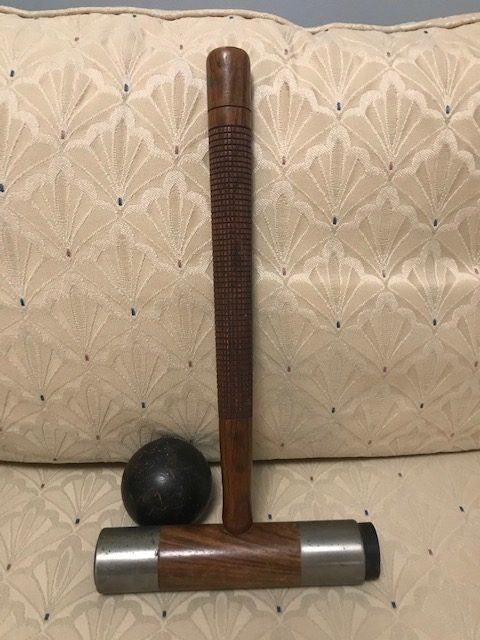
At my dad’s funeral, in March 1950, as the shock of the farm accident that took his life was waning, people talked about how much he loved to play croquet.
No, not the little league game of lawn croquet, but the major league game of court croquet!
The court, which was surrounded by a 6-inch high concrete wall, had a hard, very smooth clay surface, covered with a thin layer of sand, with 1-inch diameter iron arches.
Using a decorative short-handled mallet and a hard rubber ball that barely went through the arch, this was a game of true shots and creative skill.
Even though money from farming was short, my dad somehow found a way to pay someone to make him a beautiful, high quality, mallet. It was his symbol of the exquisitness of the game.
Croquet tournaments were becoming popular around the Midwest, and my dad had always talked about him and me playing in one.
Sadly, my dad’s bucket list wouldn’t be completed. When I started to play again, I wondered if I should use his mallet, instead of my cheaper, youth mallet. But somehow, it didn’t seem right.
But over a year after he died, in August 1951, I decided to honor my dad by using his mallet in a croquet tournament in Clinton, Illinois.
I couldn’t do anything wrong. Every shot was perfect. I won the tournament going away!
It seemed like my dad was hitting the shots, not me. And maybe he was.
Editor’s Note
This piece was originally published on the Storied Stuff website where you can find many stories about treasured objects from other people’s past.
A Treasured Watch
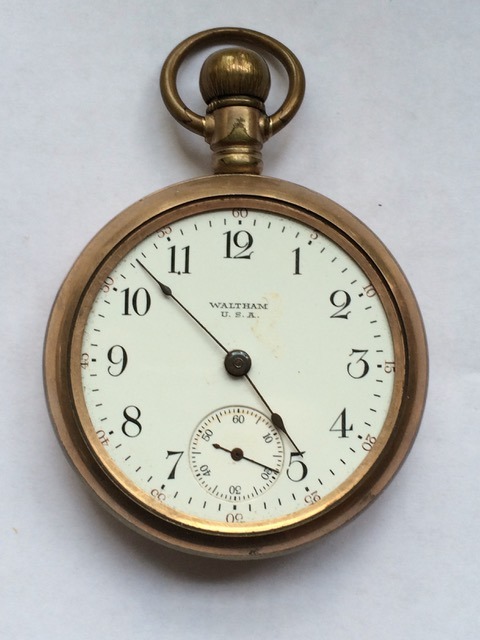
For 70 years, I’ve kept an old “gold” pocket watch in a red leather box in my dresser. It has survived 16 moves. I always know where it is, but rarely look at it.
Recently, a friend mentioned that he had restored an old pocket watch he owned, and I wondered if I should do the same.
So I forthwith took my watch to the watch expert and asked him, with positive anticipation, if it was worth restoring.
“Well,” he said, after giving the watch only a tad more than a cursory glance, “I wouldn’t mess with it. Pocket watches like this are a dime a dozen.”
On the way home, the more I thought about the watch, the angrier I got. A dime a dozen, indeed! He didn’t really know anything about my watch, and strangely, I had ignored what I knew about it too. I realized again how valuable my watch really was.
The watch belonged to my father Ray Odaffer. It was bequeathed to me after he was caught in a post-hole digger and killed in a farm accident when he was 49 years old and I was 15 years old.
My dad liked this watch and always carried it (as on the day of his accident) in the watch pocket of his overalls. Perhaps watches like these are a dime a dozen, but my watch is priceless.
I shouldn’t have needed a watch expert to tell me that.
Editor’s Note
This piece was originally published on the Storied Stuff website where you can find many stories about treasured objects from other people’s past.
Piggy Mask
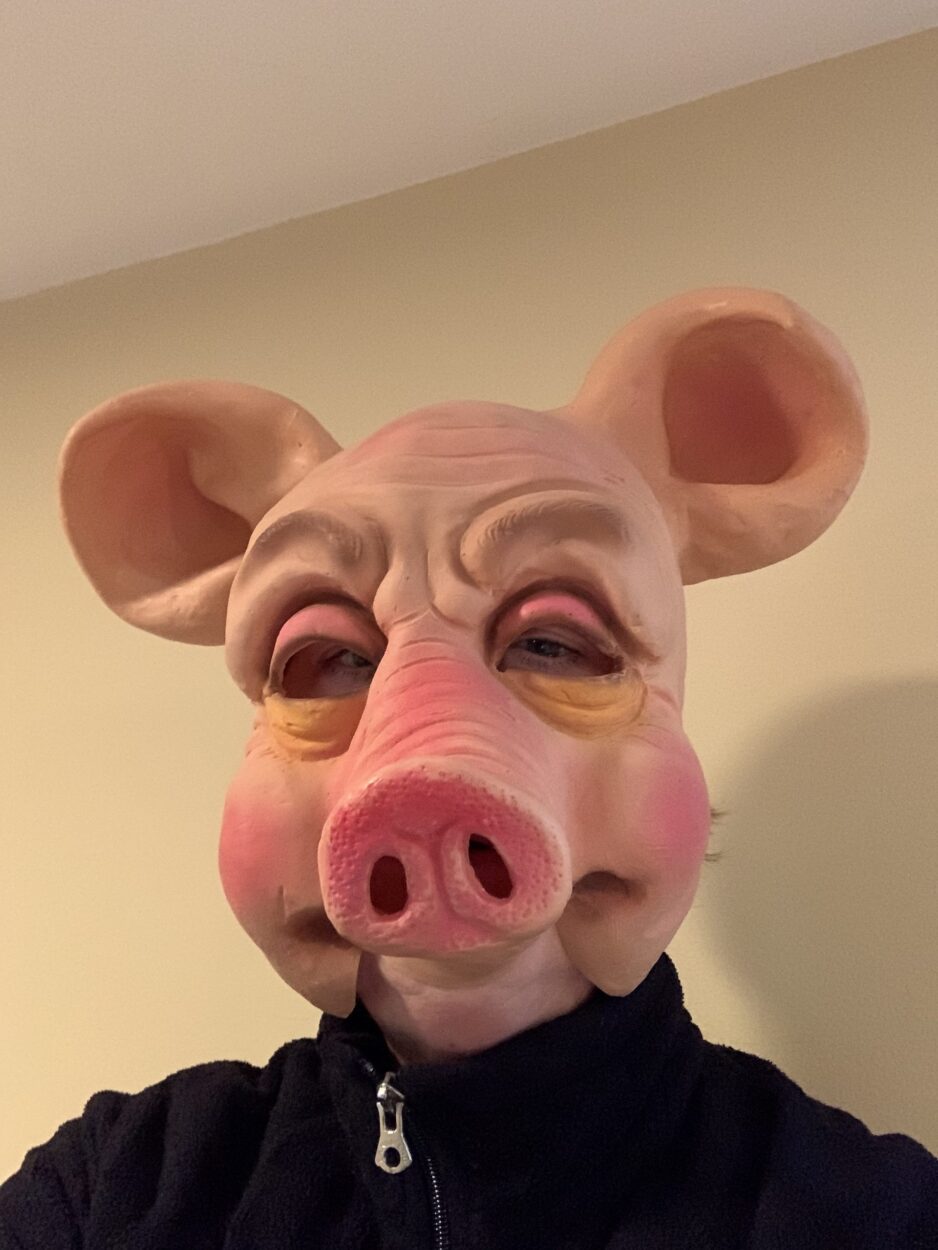
I can’t remember why I bought this rubber piggy mask 28 years ago. I think I wanted to use it to joke around with my family and scare people when we were together at my parents’ house on Lake Bloomington in Central Illinois.
You know, like putting on the piggy mask and lying down in someone’s bed or knocking on the front door.
After I pranked my brother-in-law Bruce and we had a good laugh, he put on the mask and snuck up on his four-year-old daughter Jordan.
“Oink, oink,” he said, his voice muffled by the plastic mask.
Jordan took one look at him and let out a piercing, terrified scream and went running down the stairs looking for her mother.
Startled by her reaction, Bruce took off the mask and tried to show Jordan that it was really only him. But she wouldn’t have any of it. She was really scared.
After that, I put the piggy mask away for a while.
The last person to wear it was my husband Richard, who decided one Halloween to answer the door with it on to scare trick-or-treaters. A few of them screamed. But none ran away.
Editor’s Note
This piece was originally published on the Storied Stuff website where you can find many stories about treasured objects from other people’s past.
My Rifle
I didn’t have a “love affair” with that old Winchester 22 rifle. Maybe it was a “really like affair.”

It belonged to my grandfather, and then to my father. When 12 years old, I used it to shoot rabbits, squirrels, snakes, tin cans off posts, and anything else I could think of.
As I grew older, adhering to Albert Schweitzer’s idea to “never destroy life that breathes, unless it is unavoidable,” I stopped shooting animals with my rifle. Almost.
I broke my pact only once, to shoot a woodpecker that had been making loud noises pecking on the downspout outside my bedroom window every morning at 5 a.m. for a month. I truly believe shooting that woodpecker was unavoidable.
When my father died the rifle became mine. It was a three-generation legacy, which made it even more precious.
To further the legacy, I took my kids, and later my grandkids, to a safe spot to learn to shoot the rifle. I think they understood the tradition, and respected my attachment to the rifle.
My “really like” affair with that rifle continued, but at age 80, I found that it wasn’t allowed in my senior living community.
But no problem! It was now in fourth generation as I sent the rifle to my son Eric’s house in Sammamish, Washington, where it resides in his closet today.
And I am secretly very curious as to who will be next person who carries on the tradition of owning that special Winchester rifle.
Painting of 1021 Gregory
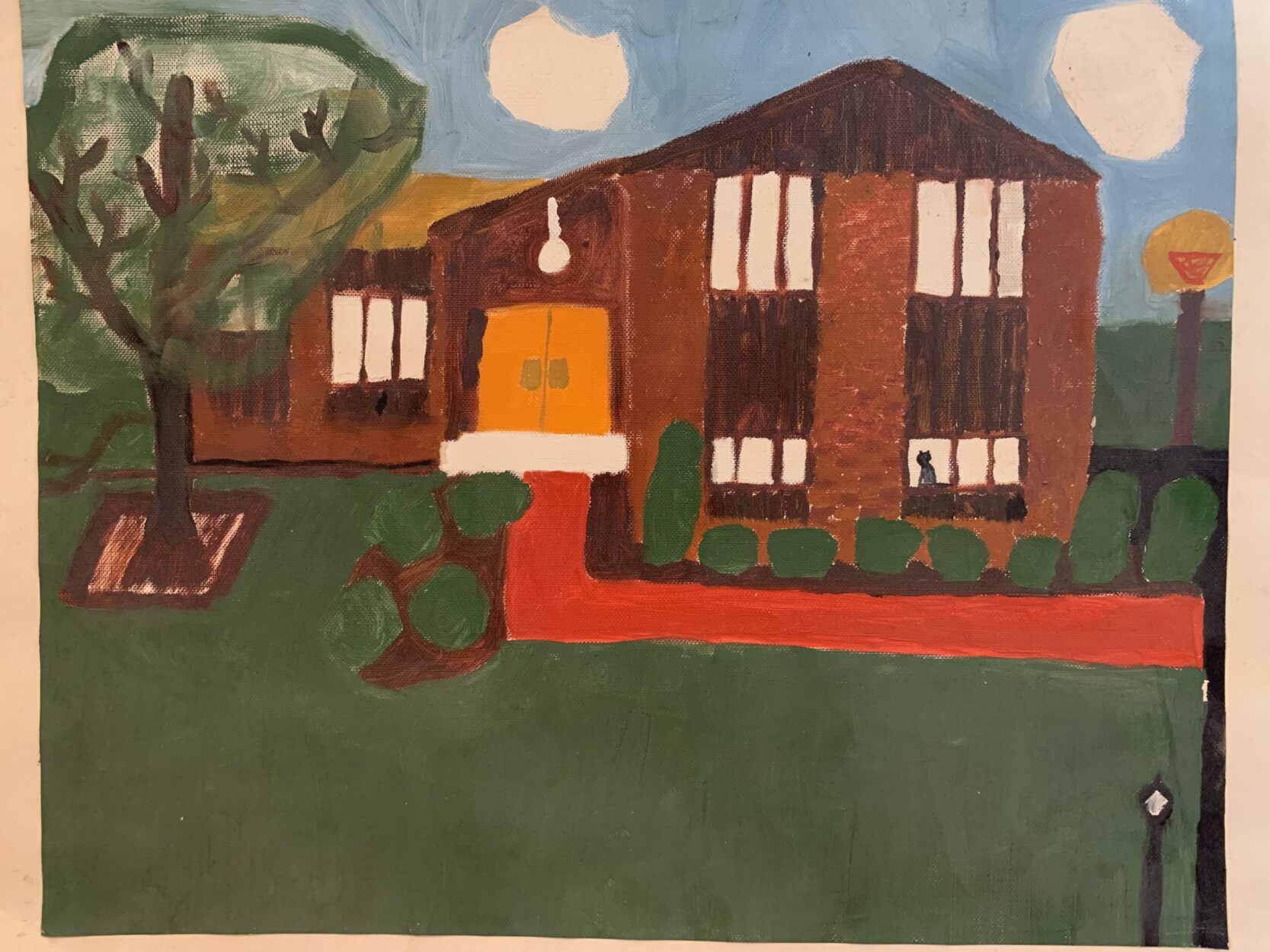
When I was 10 or 12 years old and my sister a little older than that, my parents bought us a set of oil paints, brushes, some canvases, and an easel.
“Paint,” they told us. “Paint anything.”
Having already dipped our toes in the artistic water by taking ceramics classes, we were up for the challenge.
So we painted.
Most of what I painted was pretty ordinary. Clearly I was not going to be the next Mary Cassatt. Neither was my sister.
But when I look at the painting I did of our family home at 1021 Gregory Street in Normal, Illinois, where we grew up, I think it’s pretty good.
I’m surprised by the painting’s detail, scale, and coloring. From the sloped roof to the three-paned windows and large double front door under a hanging light, the architectural features of the house are precise and accurate. I didn’t exactly capture the salmon color of the brick walls or the front door, but the brown wood panels and red brick front walk are correct.
Then there’s the gray cat in the garage window. And the basketball hoop in the driveway. A perfect green lawn. The black lamp post by the sidewalk. An exact number of bushes. The tree well.
I’m glad I kept the painting all these years. Because what I see when I look at it now is a house that I loved and the happy family that lived in it.
Editor’s Note
This piece was originally published on the Storied Stuff website where you can find many stories about treasured objects from other people’s past.
Hoot Owl
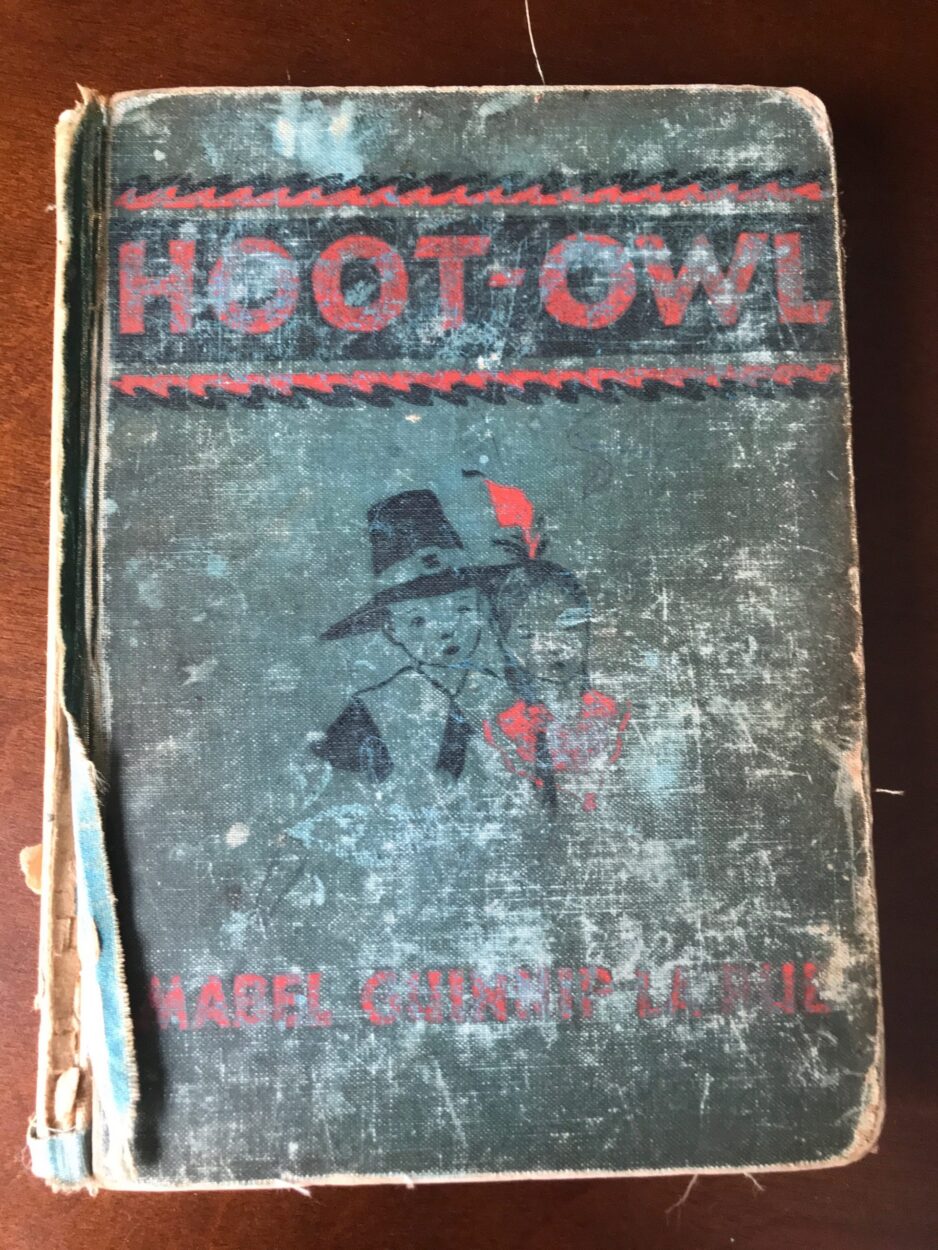
Sometimes when something special is lost for a while, it becomes more precious. So it was with Hoot Owl, my favorite childhood book.
I told a group of friends recently about Hoot Owl (not recalling the author’s name), and none of them had ever heard of it. In fact my friend, who owns a used bookstore, couldn’t find any trace of it.
Whoa! How can this be? In third grade, at one-room Prairie View School I read that book 25 times. I could probably rewrite the story from memory. Had I not remembered the correct title?
How could a little book about a settler boy who got lost playing in the forest and was adopted by an Indian tribe, just disappear in thin air?
As time elapsed, still no Hoot Owl. My friends gave me that “are you still crazy” smile when the topic came up, and I didn’t blame them.
Then one fateful day I read that Hoot Owl, by Mabel Guinnep LaRue was mystery author Charlotte Hinger’s favorite childhood book. I was sane again!
Then I found a first edition copy of Hoot Owl on e-Bay for $6,400, but it was too rich for my blood.
About a year later, a person in Ohio wrote that he would sell his pretty worn first edition for $250 so he could buy his little daughter a special birthday present.
Hoot Owl is on my desk. I don’t care what it’s worth. I know its value in my heart.
Editor’s Note
This piece was originally published on the Storied Stuff website where you can find many stories about treasured objects from other people’s past.
A Poetry Journal
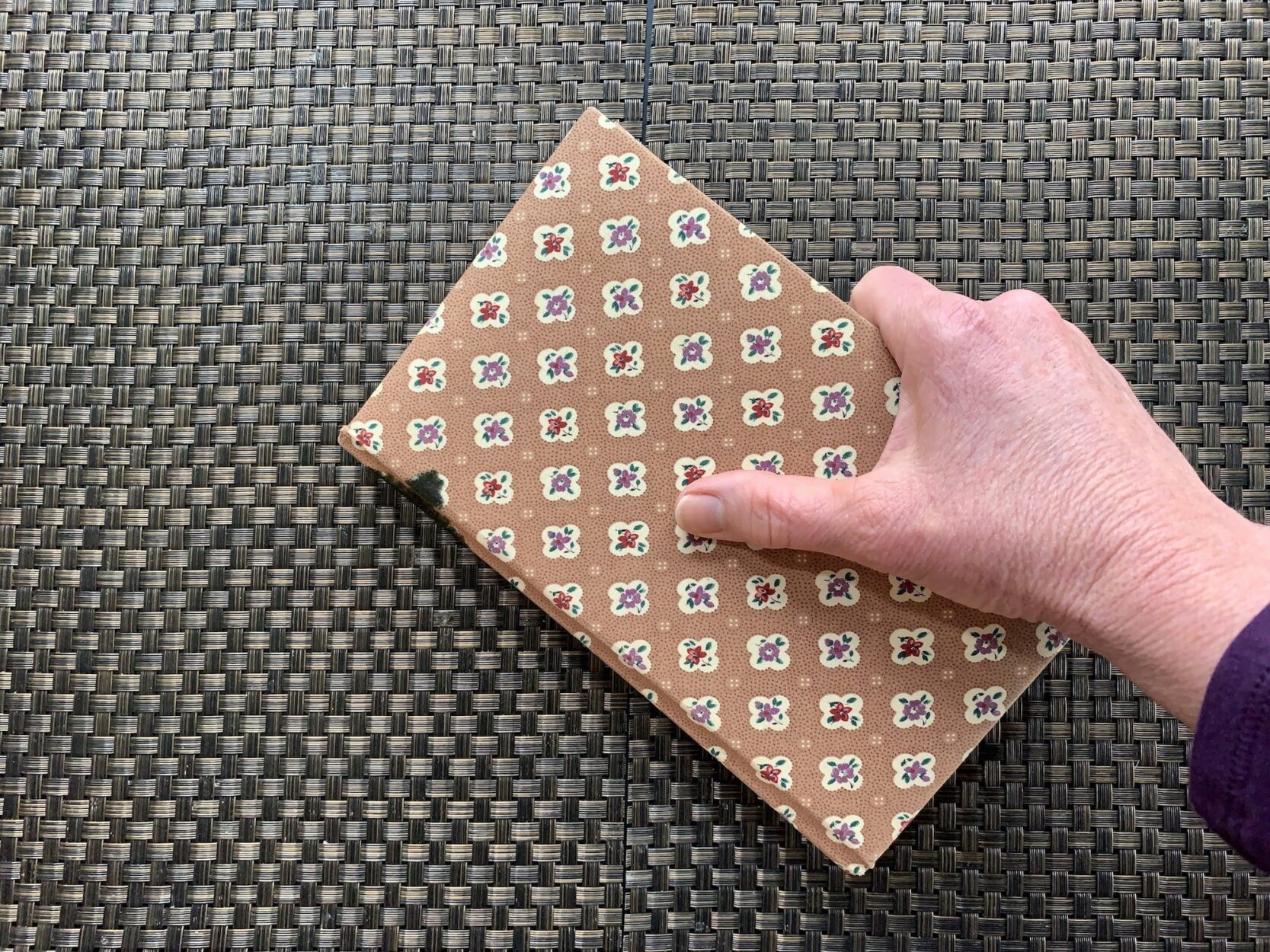
The journal’s inscription reads, “For my Grandma: this book is yours to write whatever you choose…a poem, a story, or a nice thought – all of which you have many…Love, Sara”
I gave this journal to my grandmother Ruby Atteberry in December 1982 when I was 23 years old. My dad gave it back to me in January 2000 after she died at age 97.
It’s filled with handwritten copies of the poems she started writing and sharing with family members when she was in her 50s.
A farmer’s wife with only a high school education, Grandma Ruby worked hard her whole life. She was smart, kind, and thoughtful – observing those around her and the modern world with wit and wisdom.
Her poems had a unique rhyming style that we dubbed “iambic Atteberry.” She wrote about people, her childhood, family events, society, and other musings.
As the self-appointed guardian of Grandma Ruby’s poems, I cherish and love them as much as I did her. She was truly rare.
I always wanted a red balloon.
It only cost a dime.
But Ma said she didn’t have the time.
And also she didn’t think it was worth the dime.
She could of said “maybe.”
She could of said “yes.
But she didn’t.
Now I have the money.
No one can tell me how to spend my dime.
And I have lots of time.
The balloon is in the store.
But something in me has died.
I don’t want it anymore. – R.A.
Editor’s Note
This piece was originally published on the Storied Stuff website where you can find many stories about treasured objects from other people’s past.
The Picture
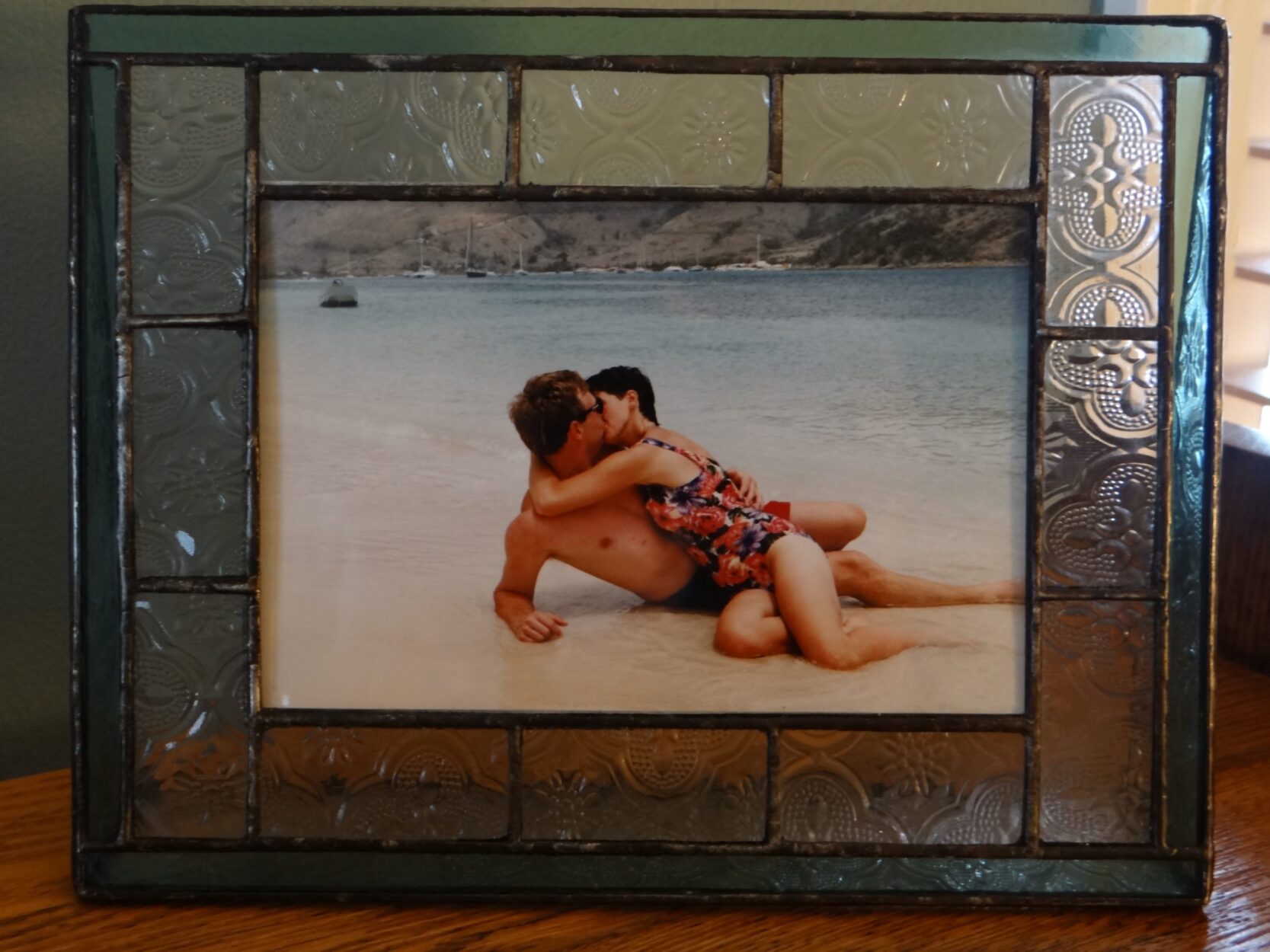
Movies have always felt very real and personal to me.
As a young teen, I went to Butch Cassidy and the Sundance Kid with my dad. I sobbed at the end when the two outlaws died. Concerned by my strong emotion, dad told me sternly, “Sue you need to learn that movies are not real life, or you’re going to have a tough road ahead.”
Fast forward to 1986, when Bruce and I were on our honeymoon in St. Maarten. We had spent the afternoon in a secluded cove, snorkeling and sunning.
The scenery triggered something in my memory. A movie scene flickered to life. I could see the lovers Burt Lancaster and Deborah Kerr stretched out on the beach, kissing hungrily as waves washed over them.
I grabbed Bruce and told him I needed him to do something for me that required careful orchestration. Bruce allowed me to position him on the white sand, water lapping at his feet. I draped myself over him and explained, “We’re recreating a famous movie scene. No time to describe it. We need to make out.”
“Right here on the public beach?” Bruce asked.
“Yes, right here. Right now. Go!” I had made him an offer he couldn’t refuse. Click.
While not an exact replica of the movie shot, it’s close enough that most viewers immediately say, “OMG, that’s the famous From Here to Eternity scene!”
My best friend Suzy saw The Picture and demanded to have a copy. Movie magic made real. And an image for all eternity.
Editor’s Note
This piece was originally published on the Storied Stuff website where you can find many stories about treasured objects from other people’s past.