
My Evolving Interest in Family History (and the DAR)
- At December 26, 2013
- By Kay Odaffer Smith
- In All Posts, Genealogy, Guest Posts
 0
0
Greetings! My name is Jeanne Kay Odaffer Smith and I will be posting about my interest in Odaffer family history and the process I subsequently went through to have one of our ancestors, Johann Wolfgang Odaffer (Odoerffer), declared a Patriot and listed as such by the Daughters of the American Revolution. But first a bit of background and my reason for putting the effort into this declaration.
My Background and Our Early Odaffer World
I was born in Jacksonville, Morgan County, Illinois in 1945. My father, Harold Odaffer, has five brothers and sisters and they were the only Odaffers we knew about, except my grandfather Ray Odaffer’s two brothers, neither of whom had children.
My father had been in the Coast Guard during World War II and stationed in New York and Rhode Island. While there and when we took the Great American Road Trips to see the West in the 1950s, he always searched telephone books for Odaffers but found none. There was speculation that the family was Pennsylvania Dutch or even possibly Norwegian.
One of my uncles, George Odaffer, married a German woman and brought her home with him. She knew of people in Germany named something that sounded like Odaffer but wasn’t spelled exactly the same – maybe Oderffer. That was all we knew.
Our Odaffer World Expands
In about 1975 the “Odaffer” world began to open up for me when our daughter came home from one of the early primary grades with a mathematics textbook written by Phares O’Daffer. How shocking! While not spelled correctly (wink, wink), this was my first clue that we were not the only Odaffers on the planet.
Several years later my husband and I attended a performance of the Springfield, Illinois, Symphony which was performed in Bloomington, Illinois. In the program was noted the financial support of Mr. and Mrs. Phares O’Daffer. Aha! He doesn’t live too far away…but I left it at that.
A few years later, possibly sometime in the late 1980s, one of my Odaffer aunts was contacted by Phares and asked for information about our branch of the family. He told her the family background and left a lengthy document with her.
I must say there was a lot of skepticism. A Hessian who fought against us in the Revolution? Come on.
And there was also, strangely, some fear of the unknown. Some, including my father, now had no interest in learning the history of the family, suggesting that perhaps there were some deep dark secrets that perhaps we didn’t want revealed.
Phares’s documentation was the first we, the Morgan County Odaffers, learned of the O’Daffers living just a bit to the east of us in Piatt County, Illinois. And (here’s the deep dark secret) my great grandfather was married before and left a woman and several children when he divorced her and moved to Western Illinois.
There he had married my great grandmother and fathered three sons. I wasn’t even sure “regular” folks got divorces back then but apparently they did!
My Quest to be a Daughter of the American Revolution Begins
I had neither the time nor ability to do any further research but simply accepted Phares’s good work. However, when I retired and realized a lot of my friends from other organizations in Springfield, where we were living, were also members of the Daughters of the American Revolution, I became curious about what I would need to do to be able to join.
Would they even accept the descendant of a Hessian Turncoat?
After a brief conversation with the Registrar of the Sgt. Caleb Hopkins Chapter, located in Springfield, I was told that it didn’t matter how my ancestor began the war; it was only important on which side he was at the end. Well okay then!
I had no trouble with records of births, marriages and deaths occurring in Morgan County. This took me back through my great grandparents, the aforementioned David and Julia Frazier Odaffer, my great grandparents.
Of course newspaper clippings are often useful as supporting proofs for genealogy, and in the obituary of David Odaffer I discovered a shocking fact – the existence of his first wife and the children by that marriage were mentioned in David’s obituary when he died in 1918.
My grandfather, Ray, was 28 years old in 1918, literate, and certainly knew of the existence of his step- brothers and sisters, but chose never to tell his own children about them.
After all of that discussion about where we came from, he didn’t say a word. He was a bit hard of hearing but not that deaf! It must have been something that embarrassed him and he stayed mum, leaving the rest of us to wonder and search.
I’ll blog soon about my quest to have the DAR acknowledge Johann Wolfgang Odaffer as a Patriot – a long and frustrating, although ultimately successful process.
4 Tips for Better Genealogy
- At November 30, 2013
- By Phares O'Daffer
- In All Posts, Genealogy
- 1
Whether you are just starting, or are an accomplished genealogist, I would like your reaction to these four tips for better genealogy.
Applying these tips, even more than I did, would probably have helped me in my quest to find out about the Odaffer family. Each tip is illustrated by where I used it and how it helped.
Tip 1 — Leave No Stone Unturned
I’m amazed that my 16-year-old son Eric agreed to go on a genealogy trip with me, and how well he resisted the inborn need a 16 year old has to rebel against adult imposed endeavors — except maybe at the very end of our trip.
Looking for signs of my great grandfather, David Odaffer, we ended up in an old cemetery near Circleville, Ohio. Our well had run dry — no Odoerfer or Odaffer graves to be found. It was time to go home.
It was then that I spied a pile of old stones, out in a back corner of the cemetery.
“Come on,” implored Eric. “You’re not going to find anything back there. Let’s get out of here.” I finally got Eric to help look through the pile of stones. On the bottom of the pile — literally the last stone — we found a dirty, barely legible piece of a broken gravestone.
We brushed it off, and with great excitement read “Ida May, daughter of D. and A. Odaffer, Died April 2, 1861. Aged 1 yr, 9 mo, 2 days.” We had located David in Ohio!
I gave Eric a short speech on the value of thoroughness and persistence in genealogy, as well as in life — a lesson I’m sure he really only learned by himself when he got older.
Tip 2 — Call or Write Often
Over the years, whenever I was in a different city, I checked the phone book, sometimes finding an Odaffer, and gave them a call.
I had to work hard not to get hung up on, but it usually worked out. And I often found out something new about the branches of the Odaffer family.
And I have written many letters to county clerks, church officials — you name it. Sometimes it paid off too.
On a trip, I had stopped at the Church of the Latter Day Saints Genealogy Library in Salt Lake City, and was about ready to leave when someone on the staff told me that he would help me prepare a letter in German.
With his help, I wrote letters to three Lutheran churches in the area near Nuremberg, Germany, where I suspected some of Johann Wolfgang’s relatives might have lived.
Amazingly, I soon received a letter from Georg Odoerfer, a member of one of the churches, who became a contact in Germany and a good friend.
Georg gave me a lot of help, often translating from books written on Old (High) German, to gather information about the Odoerfer family.
There is no doubt that making the right calls and writing the right letters can really be helpful in finding out about your family.
Tip 3 — Don’t Believe all You Hear
I talked to an older relative in our family about my great grandfather David Odaffer. She was old enough to have known David, and was a really valuable source as I delved into his life. Or so I thought.
She told me, “David came from a wealthy family in Ohio, and migrated to Illinois with $1000 sewn into his shirt. His wife Amanda wanted him to buy a farm near Monticello, Illinois, but he fooled all of his money away on drink.”
Upon checking this out, I found that there is plenty of evidence that the “wealthy family” label wasn’t accurate, and an abstract in the County Court House in Monticello showed that David bought 69 acres of land — soon after he got here — from John Dove for $1,360.
So you have to verify — check and recheck — the verbal information you receive. Sometimes people make the stories be the way they wanted them to be, not always reflecting the truth. The relative didn’t like David, and that may have colored her story.
Tip 4 — Record, Then Record a Little More
Everybody needs an Al Field. I had been working on the Odaffer family for several years before I met Al, who, being a relative, was also researching the family.
I had collected a lot of information about the family, probably more than anyone else.
And I knew that what I reported was true, since I had gotten it from very good records and sources.
But Al shocked me by demanding documentation, and in some cases, I didn’t have it. Oh, I’d had it once, and thought I had written it down carefully. But, lo and behold, my records just weren’t complete enough. I would record some basic information, but not enough and in not enough detail.
Al simply opened my eyes to the fact that you have to have a very good recording system, and you have to religiously record, and then record some more.
I got better at recording what I found, but some of the original gaps are still there, and I regret that I didn’t meet Al earlier. Thanks, Al.
So there are the four tips. Use them if they merit, and look for more hints to come!
God’s Grand Plan or Lucky Random Chance?
- At November 23, 2013
- By Phares O'Daffer
- In All Posts, Genealogy
- 0
You probably knew that a serious post would come sooner or later, so join the solemnity and consider the question, “What are we to make of our ancestor’s near brushes with death?”
I think the life of Johann Wolfgang Odoerfer, the Hessian soldier who is my (and maybe your) ancestor and link to Germany, makes us think about this question.
A Brush With Birth
Johann Wolfgang was almost not born. His father, Marcus was the 13th child in the family — an unlucky number at that. And evidence is that he almost died at birth. No Marcus, no Johann Wolfgang, no me (or maybe you).
Some Brushes With Death 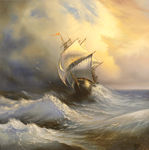
Also, Johann Wolfgang, as a soldier, had some near death experiences.
On the ship the Hessian soldiers sailed on to America, many soldiers — even one of Johann’s friends, died of malaria. Johann Wolfgang was spared.
When Johann Wolfgang was quartered in Rhode Island, the famous 22-ft. snowfall was devastating. Many soldiers froze to death, or got lost in the storm, were covered with snow, and died. Johann Wolfgang lived through this ordeal.
In the battle of Yorktown, Johann’s regiment was shelled unmercifully by their enemy, and was left to fight as the rear guard as Cornwallis attempted to escape by sea. Had Cornwallis not been compelled to return because of violent waters, Johann Wolfgang and his regiment would surely been annihilated by the overwhelming French and American forces.
Johann Wolfgang was captured in the battle of Yorktown, and forced to make a grueling march from Yorktown to Winchester Barracks prison in northern Virginia. The conditions in the prison were terrible, and a high percentage of the prisoners — not Johann, however — died of dysentery or other diseases.
A Question About Life
For sake of discussion, let’s assume that if Johann had died or been killed before he had a chance to sire Henry, his ancestors in that line would not have existed.
Pretty serious stuff, which could make those of us who are Johann Wolfgang’s descendants ask, “Am I here because Johann stayed alive by Lucky Random Chance, or because the whole scenario was a part of “God’s Grand Plan?”
This is a mysterious question, and some of the events related above and others — such as the violent waters that forced Cornwallis’s return to the battle of Yorktown — suggest to some that more than chance has to be at play here. But each of us has his/her own ideas about the bigger question, and we will probably never be able to prove that our ideas are correct.
The Bottom Line
But one thing we can hang our hats on is that Johann Wolfgang Odoerfer was one in a long line of courageous ancestors — with their warts and all — who gave all they had in their own way to pave the way for their descendants who followed them.
I guess that’s about all anyone can do, hopefully with God’s help.
10 Geneology Taglines and Tales
- At November 09, 2013
- By Phares O'Daffer
- In All Posts, Genealogy
- 1
Yes, there is humor to be found in genealogy. The 10 tantalizing taglines below can be found in various places, with no indication of who first said them. So I apologize for not being able to give credit to the originators, but thank them for glimpsing humor in genealogy and passing it on.
Enjoy the taglines, and the little tale, or observation about genealogy that comes with each one.
Tagline 1: Genealogy research — what I’m doing when I don’t know what I’m doing.
 I have alluded to the possibility that I am a “stumbleologist” rather than a “genealogist.” Often, I have just searched and searched and finally stumbled onto something good. Like just happening to talk to an old guy in a library in Clear Spring, MD, who told my son Eric and I that John Odoerfer worked on the nearby John Mason Farms (Montpelier Estate, right), opening up a wealth of information about our ancestor.
Tagline 2: To a genealogist, everything is relative.
 What a treasure trove of information you can get from talking to a relative. When I first started looking for my family tree, it was the photos, letters, and newspaper clippings in my Aunt Grace’s attic, along with her memories, that got me started. I did get a little suspicious, however, when Aunt Grace (left) told me that my great grandfather David had blond hair and blue eyes, given that all the other Odaffers I knew were black hair and brown eyed wonders.
Tagline 3: So many relatives, so little time.
The Odaffer family tree in this website contains over 1,200 relatives. And I am sure that just scratches the surface — thousands more in Germany, way back. And there are probably many more, uncharted in the United States. It is a work in progress – like a significant mountain, you just climb it because it is there.
Tagline 4: Genealogy — chasing your own tale.
Sure, a genealogist really wonders how he or she got here. There is a story out there, and all the details of the story will never be found. Now it is a short tale, but gradually getting longer. It is a bushy tale, with lots of strands. Ah, the satisfaction of grooming that tale!
Tagline 5: Cemetery — a marble orchard not to be taken for granite.
 Genealogists spend a lot of time in cemeteries, and even looking for cemeteries. After searching a while, I went out on a blustery, cold winter day to find an old, forgotten country cemetery near Monticello, IL (right), that had a lot of my relatives buried in it. Too cold to be doing it at all, I photographed the stones, and recorded the names.
Two years later, I returned to re-look at that cemetery. It was totally gone! Luckily, people who cared found the stones, vandalized, down by and in a nearby creek, and restored the cemetery as best they could.
Tagline 6: That’s strange; half my ancestors are women.
We sometimes, unfortunately, forget that it takes two, a man and a woman, to produce a descendant. So it is not strange at all that half of my ancestors are women. But largely because of strange traditions and biases, as well as simply the ease of doing it because the male name doesn’t usually get changed, it is conventional to pay more attention to the male ancestors than to the women. But I am also working on my mother’s side of the family.
Tagline 7: Every family tree has some sap in it.
When my great grandfather David left his wife of many years to marry a much younger woman, I though a bit of a sap had been found. However, as often is the case, there were two sides to the story, which muddied his candidacy for being a sap. However, there are always plenty of saps to go around in a family tree.
Tagline 8: Genealogists never lose their jobs; they just go to another branch.
I was pretty self satisfied with my classification of the Odaffers: the Illinois Branch, the Indiana Branch, the Minnesota Branch, and the Kansas Branch. I had determined that the original Odaffers in Ohio had all migrated westward to form these Branches. It wasn’t until a friend, Stan Clemens, sent me a newspaper article about Whitey Odaffer in Lima, Ohio, that I discovered a currently existing Ohio Branch, and went to work on it.
Tagline 9: My ancestors are hiding in a witness protection program.
I have tried to find out what happened to Maria Magdalena, Johann Wolfgang’s wife from Germany. No matter how hard I try, I can’t find a record of her death, nor the place where she was buried. I have contacted the church she probably attended, and they can find nothing. If I didn’t have her birth record from the church, I would wonder if she ever existed. Witness protection program, indeed!
Tagline 10: Genealogists live in the past lane.
No doubt about it. I have spent a lot of time since 1955 thinking about the past. From a search for ancestors living in Germany in 1560 to a search to solve some cold cases still open today, it has been an exciting journey — and always in the “past lane.”
4 Reasons Why Geneology is Fun
- At October 27, 2013
- By Phares O'Daffer
- In All Posts, Genealogy
- 0
Now you know that I think genealogy is a lot of fun. Here are four reasons why:
1. Everyone Loves a Mystery
I k now my great-great grandfather Henry Odaffer died — I guess because we all do. But for the life of me I can’t determine where he was buried.
His wife, Elizabeth is buried in the New Tarleton cemetery near Tarleton, Ohio, and her tombstone (right) stands there, welcoming you in, near the front gate. There is absolutely no evidence she divorced the guy, but Henry’s grave is nowhere to be found.
I have a folder full of clues, but finding Henry’s grave has been a tough nut and I am still trying to crack it.
It is an unsolved mystery of the first order. No need to buy that next mystery on Kindle–you’ve got several, ready to solve, right here in the Odaffer Family genealogy files.
2. Oh, the Places You Go and the People You Meet
A trip to Grub, Germany, to meet a relative who helped tie our family to Germany was quite an adventure.
But I was a little apprehensive as I knocked on the door of an old house in the center of Grub. I had been told that one of the oldest living members of the German Odoerfer clan lived there, and he might have some exciting tales to tell
A grizzled, but delightful, old man and his docile wife came to the door, and I knew I would be rewarded by hearing what they knew about the family.
But the biggest surprise came when they called for their daughter to meet the visitors from the States. You could have knocked me over with an old goose feather when she appeared in the doorway. She looked just like my sister Jane.
3. The Exhilarating Thrill of Discovery
I was totally worn out from the Washington D.C. meeting, but I sucked it up and grabbed a cab to the Daughters of the American Revolution Library.
After three hours of searching, all I found was a dry well. As I decided to call it a day and limp home to bed, the old saying, “Whoever said ‘seek and you shall find’ was not a genealogist” kept running around in my mind.
As I walked down the last isle of the stacks, it happened. I will never know why, but I saw, picked up, and thumbed through a single book below from the hundreds of books on the shelves.

I had never even given a thought that an O’Daffer could have been a Hessian soldier, but there he was, Johann Wolfgang Odoerfer, on page 76. And he was the connecting link between the U.S. and German Odoerfers/Odaffers.
4. Surprise Humor Around Every Corner
Finally, there was the Odaffer farmer in Ohio, who had made it abundantly clear that he wanted a son to help in the fields and take over his farm. He had eight daughters in a row after that fateful declaration.
So there you have it. Try it — you’ll like it. And I haven’t even mentioned the philosophical and life lessons you learn from being involved in genealogy –but that’s the subject of another post.