
Extolling The Value Of Mischief
I could get into real trouble with all of the conscientious young parents I know by espousing the idea that mischief among the young contributes greatly to their healthy growth.
But I can think of nothing worse for a young boy or girl than a childhood or teenage life without at least a pinch of mischief.

And how stilted would an adult would be who had never freed himself or herself up for a spoonful of mischief?
I think the occasional mischievous twinkle in the eye is the hallmark of a well-adjusted individual.
If the ability to be a little mischievous from time to time isn’t just genetically there, or allowed in childhood, it probably isn’t going to ever happen later.
And that would be a pity.
It Depends on How You Define Mischief
Before getting any deeper into trouble with you parents who have enough trouble as it is, let me assert that I‘m not talking about really destructive mischief, or just plain meanness, excused as mischief.
Rather, I’m referring to what I call “good natured” or “wholesome” mischief.”
I will admit, though, that the line between good natured mischief and destructive, mean mischief often gets a little blurred- making it just a little risky to embrace mischief at all.
But I think the risk is worth taking. So let’s look some examples.
Example A, starring “Spray Fiddle”
My friend, Hobart Sailor, was a preacher’s kid, and a master of mischief.
Everyone called him “Fiddle,” but no one seemed to know why.
At any rate, I remember one of my first introductions to Fiddle’s brand of mischief.
We were sitting in church one Sunday, behind one of the stalwart ladies of the congregation. I think her name was Lillie.
The setting was rather peaceful. Fiddle’s father Dwight was in the middle of a long sermon, and we were getting bored, if not nearly asphyxiated by Lillie’s greatly over-applied perfume.
All of a sudden, I thought I saw a very fine stream of water emanate from Fiddle’s mouth and arch over the pew onto Lillie’s hat.
Upon questioning, my buddy I was now calling “Spray Fiddle,” whispered to inform me that if you moved your jaw right, you could spray!
I was amazed at this revelation, and decided to experiment. Lo and behold, I could spray too!
I was in a “thine is not to reason why “ mentality, and only later learned that there is an opening into a saliva gland inside the cheek, and that the proper motion of the jaw would activate it.
Fiddle and I proceeded to spray Lillie’s hat, but occasionally missed and got a little of Lillie.
I would guess that Lillie carried the mystery of the “rain in church” on that Sunday to her deathbed, or alternatively, may have interpreted it as “an act of God” commemorating her Baptism by immersion.
Example B, Starring “Sandwich Act Fiddle”
“Sandwich Act Fiddle,” as I called him on occasion, was also the cause of the only time I was ever kicked out of a class in high school.
He had found a very old ham and cheese sandwich in his locker that smelled to high heaven, and brought it to Chorus class, which met from two to three o’clock in the afternoon.
As Fiddle brought out the sandwich in the middle of our singing of “Go Down Moses,” and began his antics in reaction to the smell and his pretense to eat it, I found it extremely funny and became uncontrollably tickled. Of course, Fiddle kept a straight face.

As the sandwich found itself in odd places doing odd things, I was somewhat overwhelmed with the humor of it all.
Miss Harmony (name changed to protect the innocent) forthwith asked me to leave and go to the principal’s office.
I met our very stern, no-nonsense principal, Ernest Dickey, on the stairway leading to his office, and he asked me why I wasn’t in chorus.
I told him all the smelly details, and, without a reprimand, he told me to go sit in his office until the period was over, and then go to my next class.
Lucky for me, Mr. Dickey had been my Sunday school teacher for several years, and was convinced that I was a “fine young man,” not in need of dramatic punishment. Ah, the value of “connections.”
But there was no doubt that Sandwich Act Fiddle was the master of mischief.
The Gift of Mischief
From short sheeting and putting hands in warm water at Boy Scout Camp, calling to ask the local grocer if he has “Prince Albert in a can,” to making up weird names for teachers and animal names for friends, kids in Weldon were moved by the spirit of their friend, Mischievous Fiddle.

And many of us–even today–when contributing or appreciating a pun, making a funny remark, engaging in a practical joke, or becoming involved in any mild form of mischief that shines up our otherwise dull day–subconsciously thank Fiddle for his delightful gift of mischief.
Conclusion
Mischievous Fiddle- who enjoyed a long and stellar career as a Methodist Minister and District Superintendent in Michigan- has now passed away.
But his spirit of mischief lives on, and I know he would agree with me in believing that mischief, often accompanied by that certain twinkle in the eye, sort of flushes the stagnation from the soul, and seems to go hand in hand with a more creative approach to life.
It is the seasoning that needs to be sprinkled on the personality, and it is the therapy that puts things in perspective.
So please don’t underestimate the value of mischief in making life interesting and keeping you well adjusted– at any age!
The Importance of Healthy Marriages Through the Generations
We are in the season of Mothers Day and Fathers Day, so I find myself thinking about marriage and the family.
In a recent book (On God’s Side…) by Evangelical Christian author Jim Wallis, I saw the following statement.
“Stable Marriages are at the core of healthy households, and they are critically important for good parenting… without a critical mass of healthy and functional marriages, a society steers into real trouble.”
Wow! So everyone in my genealogy database who was married and had children could have contributed to that critical mass of healthy and functional marriages–a necessary condition for keeping “our society out of real trouble!” Pretty heady stuff.
But I wonder how those who were good marriage partners learned how.
Musings About How People Learn(Or Don’t Learn)To Be A Good Spouse
There were certainly no courses in my elementary or high schools about how to be a good marriage partner.
And, unlike the “birds and bees” sex education discussions that parents are supposed to try to have with their children, no one ever set me down and talked to me about how to be a good husband.
Neither my Sunday school teachers nor the minister who married us gave me any inkling about how I could be a good spouse.
I guess I was rescued just a little bit by a good Marriage and the Family Living course I took as a college student, and a book I read by Dr. Spock (he really wasn’t that bad).
But generally, it seemed that I had to learn by example, or just by doing—obviously not very systematic instruction geared for success.
So How Can A Person Be Helped To Become A Good Spouse?
I know “just telling” is not the most effective teaching method, but if I could go back in time to talk to all the young married couples in my genealogical data base, I would at least start by giving them a copy of the “Ten Love Habits of Highly Effective Spouses,” shown below.
I compiled/created this when my son Eric and daughter-in-law-to-be Stacy were planning their wedding in 1994, and have given copies of it to my children, and to several other young couples since then.
It doesn’t seem like much, but if you continue to think about it over the years—and even take it seriously– you might conclude that “Hey, there’s something important here after all.”
*******************************************************
Ten Love Habits of Highly Effective Spouses
RESPECT
Love is creating an “us” by nurturing each “me” – with guidance from “Thou.”
ACCEPTANCE
Love is accepting each other, rather than expecting to make an imperfect person perfect.
SUPPORT
Love is looking for the best in each other and what they do, and putting it into words.
COMMUNICATION
Love is patient listening, talking, and planning in a true partnership.
GENEROSITY
Love is letting it sometimes be 40-60 rather than insisting on 50-50.
HUMOR
Love is laughing- especially at ourselves- and having fun together.
CONSIDERATION
Love is doing and saying things that make each other feel good, rather than feel irritated.
PRIORITIES
Love is focusing more on the kind of you living in a house than on the kind of house you live in.
FRIENDSHIP
Love is being a best friend, knowing that true friendship is a union of two good forgivers.
GROWTH
Love is agreeing to work toward positive marriage habits, knowing that it is natural to falter.
Created/Adapted by Phares O’Daffer, May 28, 1994
**********************************************************************
The Bottom Line
Maybe it’s worth continuing to say things like this (or one’s own personal version) to our kids and grandkids, in the hope that it will become meaningful to them, or spark meaningful thoughts, and they will pass it on to their kids and grandkids, and so on.
If we can do even a little thing to maybe “help keep society out of real trouble,” it’s probably worth it.
A Tribute To My Mother
Introduction
On this Mother’s Day, 2015, I am reminded of my mother, and of a tribute I wrote to her when she died on January 4th , 2000.
Today, in her honor, I will post the tribute, and think back on her life.
I hope it will stimulate you to think of your mother, and of great mothers everywhere who have given all they had to raise their children and prepare them for their place in the world.
Ruby Gray Odaffer Atteberry (April 1, 1902- January 4, 2000)

My Mother, Ruby Odaffer Atteberry
Ruby – mother, mother-in-law, grandmother, relative, neighbor, and good friend. She was so special to many of us- a unique lady who we greatly enjoyed, and who will always have a strong, positive influence on our lives.
Maybe, somehow, we will find a way to tell her story to future generations, and impart some of her character and values to them.
A common comment from people of all ages who visited Ruby, was “I really enjoyed talking to her.”
What was there about this lady, who was born near Lane, Illinois, grew up in Weldon, Illinois, and lived near her home territory all of her life, that caused people to make this comment?
Ruby, always true to the lack of material possessions in her early life, never had very many extra wants or needs. She always had great respect for her family heritage, and continued to remember them through her poems, her interest in her ancestors, and her untiring support of the annual Gray Reunion.
As a woman who was valedictorian of her high school class, clerk in her uncle’s store, a country school teacher, a hard working farmer’s wife and mother, a superb cook, and an egg candler and chicken dresser, Ruby believed in working hard and doing a quality job.
Her memory was phenomenal… She could remember extraordinary details of what happened from when she was 2 or 3 years old on, as well as almost anything she had ever read. On nights when she couldn’t sleep, she would recite poetry or famous speeches she had memorized. She once said that she had recited for over two and one half hours.
She also loved to write poetry. When there was a plan to remove the statue of Abe Lincoln from the Clinton, Illinois square, it was Ruby’s letter to the editor with a poem that helped save the statue for posterity.
Her poems were always positive- and gave simple affirmation of family and spiritual values. We will never be able to read the poems the way Ruby did, but we will always read them with her special way in our memory.
Ruby was a very special mother. Her children vividly remember the love and teaching she gave, and her support through their growing years.
I remember, as a first grader having trouble learning to read, her sitting me on her lap and teaching me phonics in one evening. I never had trouble with reading again!
She taught her daughters and daughter-in-law the techniques of taking care of babies, and her simple, but effective, principles for raising children.
Ruby was always deeply interested in what her children, grandchildren, and great-grandchildren were doing, and dearly loved them all. To them, she was the “world’s greatest grandmother.”
She was loved not only by her grandchildren, but by the many neighbor children who also stopped by to talk with her, play Chinese checkers, Dominoes, or Aggravation, and sample some cookies. She had a special way with children, and they loved being around her.
Current affairs and “the state of the world and its people” always were of great interest to Ruby. She loved to talk about how things are, and compare them with how they used to be.
Her simple, straightforward approach to life was inspiring and contagious.
In her later years at Meadows Home, Ruby was always mentally alert. She adapted admirably to her many physical problems, and when asked how she was feeling, she either said “tolerable” or “with my fingers.” Her sense of humor was always in evidence.
When I fixed her clock and told her “That will be $10, please,” She came back with “Charge it!” Or when I cut her hair and said “You look like a million dollars!,” her quick response was “Without the zeros.”
Not long before she died, I told her that her situation was Y2K incompatible because her gravestone read 19 – – , and that if she lived to the year 2000, she would have a problem. Ruby gave that little smile, and told me “I’ve got worse problems than that, and anyway, I think that is more your problem than mine.”
As a young child, Ruby had perfect attendance for a long period of time in Sunday School and Church. In later years, she had a perception that her simplicity didn’t fit in, and didn’t attend Church much, but seemed to always live according to Christian principles, and approached life with a deep faith that just seemed to be a part of her.
To the end of her life, she seemed to always be thinking of others, and was amazingly generous with her caregivers. She rarely complained when we went to see her, and when we would leave for a week or two on vacation, she never gave us a guilt trip, but always simply said “you have a good time.”
Ruby once said that an uncle had told her as a child that she was made out of “rags, tags, and old paper bags,” and, in a very real sense, she never pretended to be made of anything much more fancy. She never put on airs. What you saw was what you got. She was Ruby.
But she had a special way, a depth of character, a simplicity, a way of relating to us that we will never forget.
We all know that she was made from very high quality stuff, and we love her very much.
Phares Glyn O’Daffer, January 4, 2000
Thrilling Days of Yesteryear
The Great Depression
Maybe some of you remember January,1933. Or maybe not.
It was the time of the Great Depression, and our country and people were in a real mess.
The Stock Market had crashed and the unemployment rate was 25%. Crop prices had fallen 60% and people, with little faith in government or Wall Street, were standing in lines to get food.
They had lost faith in about everything and many felt that what they really needed was a savior.
When I saw a tiny article on a back page of our local paper, entitled “Fred Foy dies at age 89,” I was moved to tell you about a surprising savior who, I believe, really did help people emerge from the Great Depression.
Who Was The Savior?
No, I’m not talking about Franklin Roosevelt, even though he qualifies.
Instead, the savior I want to talk about is The Lone Ranger, whose radio program was first broadcast in January,1933!
And I’ll make it clear later why he was the savior.

Fred Foy
Fred Foy was the radio announcer who gave the introduction to the Lone Ranger radio program 3 times a week for over 10 years on Station WXYZ in Detroit.

The Lone Ranger
Some of you may be able to say the introduction from memory! And with the William Tell Overture racing through your head!
“Hi Yo Silver” “A fiery horse with the speed of light, a cloud of dust and a hearty “Hi Yo Silver!” The Lone Ranger. With his faithful Indian companion Tonto, the daring and resourceful masked rider of the plains, led the fight for law and order in the early western U.S. Nowhere in the pages of history can one find a greater champion of justice. Return with us now to those thrilling days of yesteryear. The Lone Ranger rides again!
Who Listened To/Watched the Lone Ranger?
 By late 1933 millions of men, women, youth, and children were listening on their battery radios to the story of a hero.

And later, when I was 9 years old, I was among them. This photo is unusual because it shows me in overalls without my Lone Ranger Badge, which was almost always there. I’m sure, in this case, my mother made me take it off to go to church.
And people would continue to listen, to read, and to watch…
- Over 3000 radio episodes in a 21-year period- on 249 radio stations.
- Four television serials from 1937 to 1957(221 episodes)
- Five movies over a span of almost 50 years (1956-2013)
- 18 Novels, Comic Strips and Comic books read by 75 million people
Who Created the Lone Ranger Program?

George Trendle
George Trendle, a ruthless lawyer and owner of radio station WXYZ Detroit, told a colleague that he wanted a program about a western hero to keep his radio station from going under in the depression.

Fran Striker
Fran Striker, a prolific writer who had already written some episodes about a masked western “Robin Hood,” was hired by Trendle- and the Lone Ranger was born!
One of Striker’s co-workers estimated that over the next 20 years, Striker wrote 60,000 words a week for the Lone Ranger program and ancillaries-equivalent to the Bible every three months.
In 1934, with the Lone Ranger enjoying ever increasing popularity, Striker was pressured by Trendle- in return for preserving his steady job- to sign over his rights to the Lone Ranger for $10– which he did!
After that, Trendle always claimed credit as the creator of the Lone Ranger.
Upon retirement in Detroit in 1954 (age 70), Trendle finally sold the rights to the Lone Ranger to the Wrather Corporation for over $3 million, and threw Striker a bone by giving him $4000.
Who Were the Actors Who Played The Lone Ranger?

Earl Glaser
Earl Glaser, the first radio Lone Ranger, didn’t look the part, so Trendle kept him away from the public and his name secret. Many other radio actors followed Glaser.

Clayton Moore
Arguably the best TV Lone Ranger was Clayton Moore, a former circus acrobat, who told Trendle when he was interviewing for the job. “Mr. Trendle, I AM the Lone Ranger.”
In 1985, Moore said, “I’ll wear the white hat for the rest of my life. The Lone Ranger is a great character, a great American. Playing him has made me a better person.”

Klinton Spilsbury
And the worst Lone Ranger ever was probably Klinton Spilsbury. His voice had to be dubbed for a 1981 movie, which was a disaster, losing $11 million.
Spilsbury received the Raspberry Award for “worst new star” of that year, and never acted again.
A Word About Tonto

John Todd, the radio voice of Tonto
Interestingly, Tonto’s radio voice was that of John Todd, a portly, middle-aged bald headed Irishman and former Shakespeare actor, who looked absolutely nothing like the image he created on the air.
Trendle occasionally slapped a wig on Todd for public appearances as Tonto, but, as you might expect, that didn’t go over very well.
Jay Silverheels, a descendant of the Mohawk Indians, accepted the TV role of Tonto in 1949, and played the role with grace and nobility. It is not difficult– with the benefit of a different time– to find negative stereotypes in the Lone Ranger radio and TV programs.

Jay Silverheels and Clayton Moore
However, as an avid listener/viewer, I always felt that The Lone Ranger and Tonto’s relationship was one of mutual respect, kindness toward each other, and cooperation.
When each called the other “Kemosabe” (meaning “trusted friend”), I believed it.
So Why Was The Lone Ranger a Savior?
In its heyday, 10-15 million people (at least half of them adults) listened to the Lone Ranger, a hero who gave them what they needed–to be uplifted, to have hope, and to escape from worry.
Scholars feel that the Lone Ranger had a profound psychological affect on listeners emerging from the Great Depression.
He was a masked man with strong moral values who fought corrupt and powerful oppressors, and through his exploits they saw possibilities for freedom, clarity, and the capacity to act.
Fran Striker even wrote a Creed for the Lone Ranger, which reflected moral and religious values the people held so dear.
One minister called the Lone Ranger episodes “bible lessons without scripture.”
Striker also wrote Guidelines for the program, which included the ideas that the Lone Ranger never shoots to kill, and he doesn’t cuss, drink, smoke, or kiss a woman!
Could The Lone Ranger Help Us Today?
Our Nation has emerged from the biggest recession in years, but many people still have a depressed feeling about their country and their lives-like those people 82 years ago in 1933.
It appeared that the Disney Corporation had learned a lesson of history when they decided to make a new Lone Ranger Movie in 2012.
If they could have helped the Lone Ranger become our psychological savior again, we would all perhaps be better off, and they could have made a lot of money.
But alas, it was not to be. In their movie– seemingly in an attempt to be modern, politically correct, and re-invent the characters and relationships– the real Lone Ranger was nowhere to be seen.
And his insufficient surrogate took orders from Tonto, cussed a little, and even kissed a woman!

The Lone Ranger and Tonto in the 2013 Movie (Armie Hammer and Johnny Depp)
The movie was basically a flop, and we are still in need of a psychological savior.
We can only hope that someday, someone will get it right.
Five Things Genealogists Hate to Hear
- At March 28, 2015
- By Phares O'Daffer
- In All Posts, Genealogy
 1
1
My first blog post emphasized how fun it is to do genealogy.
But doing genealogy also involves a pretty good-sized serving of frustration.
These stories, on the five things genealogists hate to hear, illustrate this.
Trash Talk
I was whistling a tune as I drove along, happy because I just felt in my bones that this would be a good genealogy day.
I just knew that my relatives in Jacksonville, Illinois–who I had never met– would have the information I needed about my great grandfather David Odaffer, who had divorced his wife and married a younger Jacksonville lady.
If he had blue eyes and blond hair, as my elderly Aunt Grace insisted, it would be one of the greatest “exceptions to the rule” of all times. Didn’t all Odaffers have dark eyes and dark hair, just like my dad? I needed to know more about David, and I needed a photograph!
Arriving in rural Jacksonville, I had a very nice visit with one of David’s sons with his second wife, and his wife. But when I finally got to the nitty-gritty bottom line and asked them about any photos, letters, or documents they might have about David, all my whistling stopped.
In response to my question, the demure farmers wife -In the words that all genealogists hate to hear- said “Oh, we had some of that stuff, but we cleaned out the attic in ’68 and threw it away.”
Can We Communicate With the Dead?
My good friend Stan Clemens graciously sent me a newspaper article about Whitey Odaffer, from Lima Ohio. It was a surprise, because at that time, I didn’t know about the Ohio Odaffers.
Whitey appeared to be an eccentric old pack rat, collecting everything– literally from soup to nuts.
So in a lifetime of collection, he had, the article reported, collected a lot of information about the Odaffer family.
But as I read the article, it became clear that good ole’ Whitey couldn’t pick very much written material about the family from his pile of collectables- it had to be picked from Whitey’s brain!
“I’ve got to talk to this guy,” my little brain voice kept saying, ever louder and louder.
I drove to Lima and found Whitey’s small house, but the windows were boarded up. Maybe Whitey had moved to a retirement home, I surmised, deciding which neighbor’s house to approach.
“I see Whitey isn’t living here anymore,” I said to the little old lady next door, after finally knocking on her door long enough to bring her out. “Can you tell me how I can get in touch with him?”
Uttering the words no genealogist who’s looking for someone who has special information about the family wants to hear, she said, with a sad smile, “That would be pretty hard, He died about three weeks ago.”
Dante’s Inferno
It was in the dog days of August when my 16 yr. old son Eric and I approached Tarleton cemetery near Tarleton, Ohio.

We drove into the cemetery, looking for the graves of Henry and Elizabeth Odaffer, my great great grandparents.
As we parked, Eric jumped out of the car and began shouting “There it is! There it is! It’s Elizabeth’s grave!”
Sure enough, there it was, almost the first grave we saw, and having weathered the 127 years since 1855.

Obviously, David’s grave should be next to it, but it wasn’t. It wasn’t even nearby, or even in the cemetery! Was it there once, and then washed away or destroyed?
As we looked for a source of information, almost from behind a gravestone, a small, wizened old man with a flowing tobacco stained beard appeared, grass clippers in hand.
“What can I do for ye?” he queried, not with great enthusiasm. “I’m Reynard Potts, and I take care of this place.”
Excited in anticipation, I told Mr. Potts about the grave we had found, and leaped into the question. “Can you show us the past cemetery records for Tarleton cemetery so we can see if Henry Odaffer was ever buried here?
Striking a pose of great authority, Reynard took all the wind out of our sails as he almost proudly pronounced,
“There’s no way you’ll ever find that information. The fire of 1895 burned the cemetery shed to the ground and destroyed all the records.”
Words that are like scraping fingernails on a chalkboard to the ear of an anticipatory genealogist!
Johnny, I Hardly Knew Ya
I went to Decatur, Illinois to specifically find out about two of the Decatur Odaffers.
After much searching, I finally found the house of the Odaffer gentleman who I thought would know the information about his grandfather and brother that I needed to fill in the Decatur Odaffer family tree.
My Odaffer relative lived by himself in the outskirts of Decatur. I soon found his house, and we were sitting on his porch, ready for an informative talk about his relatives.
“Well, George, what can you tell me about your grandfather and your brother? If I can find out about them, the Decatur Odaffer story will be complete”
George moved around a little in his chair, scratched the stubble on his chin, looked a me like I probably shouldn’t have asked, and said…
“I don’t know anything about my grandfather- never saw him. And I haven’t seen my brother for 40 years- no idea where he is.”
Amazing how many people say these words that are bewildering to genealogists. “I don’t know anything about them” (I.e., the people who could be close to them).
Lost and Gone Forever
Early on, in my foray into genealogy, I bought a cheap database designed to keep and display data about my ancestors.
I spent 2 days entering my data, and was proud of where I was headed in terms of keeping good genealogy records.
I was just about done when, lo and behold, on the third day, out of the blue, it crashed!
After much searching for customer support, I called ‘’’the budding company and asked for an expert who could help me retrieve the data.
“Well, said the person on the line, I’m sorry to inform you that we discovered a bug in the software that caused it to crash, and your data can’t be retrieved. So the old software is now out of print. But the revision works just fine! I can send you a copy for $49.95. ”
Not what I wanted to hear!
Conclusion
A lot of difficulty in genealogy, much like life, could be avoided if we didn’t procrastinate.
So if you want to find out about your family, start sooner rather than later.
It will help avoid good genealogical information getting thrown away, burnt is a fire, or informed relatives dying before they get to tell their story.
It may even give you more time to find out about the relative nobody knows, or to find a reliable genealogy computer program!
Why That Good Ole One Room School Was So Good
Some Introductory Musings
Maybe it was because I had just watched the movie “Boyhood,” and was thinking back on my own boyhood days, or because I had just read about some new innovations in education.
Whatever it was, I found myself thinking about Prairie View School (PVS)– a one-room school 1 ½ miles south and 2 miles east of Weldon, Illinois– where I faithfully attended for 8 years.

Prairie View School – Having Evolved from Bright White to Worn and Faded Gray.
Having turned 5 in February and really angry—I gave my mother an earful on why it wasn’t fair that my two neighbor friends could go to school and I couldn’t. Shocked by my unusual fuming and ranting — but to her eternal credit — she didn’t shut me up — she just listened.
Finally, she took off her apron, straightened her dress, and matter-of-factly said, “Get in the car. We are going to go talk with Mrs. Ball.”
Nothing scientific. Mrs. Ball, the teacher at Prairie View, simply looked me over, listened to my mother and I for 5 minutes, and said “Okay, we’ll have a trial period.”
At the end of my trial period, when I overheard Mrs. Ball say to my mother “He’s a __ little devil,” my heart skipped a beat.
I hadn’t heard the blank word, and worried that my plan to go to school was doomed.
But, somehow, I was in (little devil or not), and attended Prairie View School from age 5 through age 13.
Let me tell you, through my experiences, why I think PVS was a wonderful place.
My First Exciting Discovery
Very early on, as I sat at my little desk working on an arithmetic worksheet, I suddenly discovered that I could eavesdrop on Mrs. Ball, over in the corner, teaching the 7th and 8th graders.
What they were talking about was interesting to me, and for 8 years, I multitasked- listening to other grade level groups while completing my worksheets.
You talk about enrichment and meeting individual needs. I was never bored again!
My First Job
When Mrs. Wene, my 4th grade teacher, asked me to come to school early to help her carry in cobs and coal heat up the stove, I was really excited! And she paid me 50 cents a week to do it!!
I felt proud to be chosen, I felt trusted. I felt competent. I felt responsible. I felt satisfaction about success.
Come to think of it, that’s how I felt later in life about all my other jobs.
Being Taught life skills and attitudes… on my first job!
My Early Acting Career
Mrs. Wene didn’t ask me to be in a two person Christmas Play with my second cousin, Sharon Carr- she just acted as if it was a given—and a hillbilly romantic skit, no less.
I received raves from all the parents, and that experience made me want to later take parts in high school plays, and feel comfortable in front of people.
One of the many extra curricular activities at PVS —building confidence and learning how to do things.
My First Taste of Leadership
During the war, we had a scrap metal drive- the “Dive Bombers” and the “Submarines” teams competing- to help the war effort.

The Dive Bombers Scrap Drive, October, 1942
I was leader of the Dive Bombers- organizing the team, planning our collection and delivery schedules, and getting others on my team to collect a lot of scrap.
We were the winning team, and in retrospect I considered it my first successful project experience.
Meaningful learning and leadership training through projects. What Progressive Education!
My First Sex Education
One day, not long after I started school, all the boys hightailed it to the outdoor boys toilet at recess.
There, in close proximity to the smelly latrine, I had my first introduction to sex education.
I can truly say, looking back, that what I learned about the birds and bees from the boys at Prairie View School was pretty accurate, and sufficed until I read certain library books at Illinois State University.
Cooperative learning and Sex Education at the same time! Wow!
Me, Thee, and The Ciphering Contest
At PVS, the teacher would have us go up to the blackboard and to do long multiplication or division calculations.
If you finished first, you took your seat and waited on the others. I was hands-down the fastest cipherer in the school.
When we visited the “town school” in Weldon and a ciphering contest came up, I thought “No sweat, “I always finish first.”
Lo and behold, I was still ciphering away when a slight girl named Ada Katherine Pearl was already sitting down, with a big smile on her face.
I learned humility that day, and that there is always someone in this world who can do something better than you can.
Active involvement and developing self knowledge—in PVS!
P.S. Many years later, when I was a Professor of Mathematics
at Illinois State University, my friend, Ada Katherine Pearl, knocked on my office door.
I was very quick to make it clear that, under the circumstances, there would be no ciphering contests in the mathematics department that day.
The Essay Contest
Mrs. O’Connor, my 7th grade teacher at PVS, asked me to stay after school one day and told me that I should enter a three county essay contest for 7th and 8th graders that offered a prize of $25 for the winner.
I thought “I could use $25,” so I entered.
My essay, “From Little Acorns Big Oaks Grow,” won the contest, and was printed in full in The Weldon Record, a local paper of some renown.
Entering and winning that essay contest probably sowed the seed of interest that launched my career as a writer.
Special attention to every student and another teacher who cares. Thank You, Mrs. O’Connor!
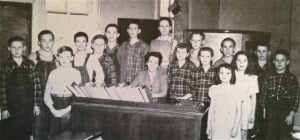
Mrs O’Connor and her Prairie View Students, 1946
Summary- What a Place in Which to Learn!
In PVS, the student teacher ratio was 15 to 1, and the 16 people in that place were one special family.
If PVS is any indication, perhaps all the “innovative approaches” we fuss about in education today aren’t as new as we think, and were being used when we didn’t even talk about them.
And maybe what’s really important is providing a loving, family setting like Prairie View School, in which a conscientious teacher cares about her students and, like each of my PVS teachers, does her very best.
Five Full Blown Farm Fears- What One Farm Boy Remembers
There were several scary things about the farm where I grew up.
I call the scary things the “Full-blown Farm Fears, and they may just have, as they say, “helped develop my character.”
Anyway, here is how I remember them.
There Were These Things Called Snakes
The first fear, without a doubt, was of SNAKES!
Whenever a brave, but unaware, snake made its way into our yard and was spotted by my mother Ruby, the result can only be described by the phrase, “all hell broke loose!”
“GET THE HOE! GET THE HOE!, ”my mother would shout, in her loudest and most authoritative voice, causing the chickens in the yard to scatter to the winds. All the troops (children, and whoever else was there) mobilized immediately, and rapidly delivered my mother’s weapon of choice — a garden hoe.
It was as if the President of the United States had learned via the red phone that the enemy was within our gates! We must defend ourselves against the attackers! And Commander Ruby led the assault.
With approximately 50 quick and vigorous chops, seemingly given in the time frame of about 5 seconds, she made triply sure that the snake had met its demise, if not its total dismemberment.
As quickly as it had started, calm reigned again, and it inevitably became my task to dispose of what was left of the snake.
You can now probably understand how a fear of snakes quickly developed within me, and still affects me today.
Yet, the snake experience also helped me develop resourcefulness, because as I grew older, I would plant a dead snake, which I had shot with my BB gun, in the most appropriate place, and wait in excited anticipation until my mother spied it.
Many a dead snake got totally demolished in its afterlife by Ruby’s trusty garden hoe.
Aren’t Windmills Gentle and Harmless?
The second big farm fear was of the WINDMILL!
It may seem strange that the windmill would create a farm fear factor, because it was such a helpful thing– pumping water out of the ground for horses, cattle, and us.
But the big fear came from the windmill’s simple on/shut off device– with it’s macabre accomplice, the high wind.
The device was a smooth stick handle tied to a wire that went up to the propeller on top.
When you wanted to turn the windmill on, you released the handle, loosening the wire and allowing the propeller blades to be turned by the wind.
When you wanted to shut the windmill off, you pulled the stick down against the tower piece, thus tightening the wire and putting the brake on the propeller to stop it.
The problem came, however, when the windmill was turned on and the wind suddenly came up. A very high wind could turn the propeller so fast that it would either break the pump or go flying off the windmill if it wasn’t breaked by pulling the handle down– and that took “three men and a boy.”
Now comes the fear. If the windmill was on and the wind came up, calmness did not abound.
My mother approached this as impending disaster. “Go turn off the windmill! Hurry! The wind is coming up fast!”, she would shout, as if the lives of all of us entirely depended on completing this task in at least one millisecond.
The intensity of it all put the fear of the Lord in me, especially since I, being a very fast runner, usually got there first (even though a strong wind blowing at a rate equal my weight tried mightily to keep me from getting there), and usually was unable to shut it off.
I can still feel the relief that ensued when a couple of us were able to pull that stick down and literally bring the propeller to a screeching halt.
I think the windmill experience must have helped me learn to deal with stress and pressure, because there sure was plenty of it when the wind began to blow on the farm.
Lightning Never Strikes the Same Place Twice
Oh Yeah??? Bill Odaffer’s barn just down the road was struck twice–burning to the ground each time–during the time I lived on the farm.
I remember getting out of bed during a storm and driving to Bill Odaffer’s farm with my parents to see if we could be of some help the first time it happened. All of the neighbors were there, and it was a roaring fire that could not be put out.
The second time, in my mind, was a rerun of the first. There was talk in the neighborhood that Bill might want to consider putting lightning rods on his next barn, but as I recall, for reasons beyond everyone’s comprehension, he never did.
By now you probably know that the third full-blown fear on the farm was LIGHTNING! Witnessing the barn burnings greatly heightened the conviction in my mind that this could really happen to us!
Our house was built okay, but it was all wood, and just a little porous. When a severe thunderstorm came upon us, you really felt that the lightning was going to tear that house asunder—especially if you, like me, slept in the upstairs, pretty close to the great outdoors.
I think the coming of lightning in the middle of the night while I was sleeping upstairs in that old farmhouse gave new meaning to what my Sunday School teacher, Ernest Dickey, always said about standing in the need of prayer.
Isn’t Fire a Good Thing?
The fourth full-blown farm fear was the uncontrollable GARDEN FIRE!
After harvest, it was fine to burn the dead grass off the garden on a quiet day, but if the wind suddenly came up, as it often did, a garden fire could get out of hand.
And there was a large gasoline tank just east of our garden, and if you are familiar with the Midwest, you know that the winds always blow from west to east.
My mother seemed to have this amazing knack of stirring up the wind.
One quiet day my mother set out to burn off a small southwest corner of the garden. Out of the blue, a good ole strong west wind came up. I was just over 2 years old at the time, but I’ve always had this feeling that I vividly remember this incident.
My mom and I were the only ones home. As the wind came up, she ran in the house, placed me in the kitchen, and shut all the doors.
Then she ran to the garden to try to stop the blazing fire before it got to that tank and, in her mind, blew us all to kingdom come.
Using superhuman force, beating the fire, running for water, and throwing dirt, she did finally contain the fire just short of the gas tank, and before having to deal, again in her mind, with a scorched earth aftershock.
When she returned to the house, she found me under attack by a baby gosling–whose box I had knocked over– and screaming bloody murder.
So I was saved by the firefighter hero of 1936, but have always been leary of garden fires and geese!
Don’t Go Near the Ditch!!
The fifth, and final major fear on our farm was the DREDGE DITCH! My mother, with all her good traits, was deathly afraid of the dredge ditch.
Part of the fear probably came from her experience of very nearly drowning as a teenager.
But when I was growing up, it seemed that she thought that if any of her children got near the ditch, it would take a couple of gulps and completely swallow them up!
She must have transferred her image of the spring rain ditch (which could get pretty violent) to the lazy summer ditch, because for whatever reason, it was like pulling teeth to get her to let us “go down to the ditch.”
The fear of the ditch was heightened by the fact that land area under the bridge often served as a camping place for Gypsies that came through the area. Since the bridge wasn’t far from our house, and Gypsies had a penchant for coming to a nearby house to beg or “borrow” things, my mother was in a dither when the Gypsies arrived.
She would send my sister Jane or I to the door to tell the Gypsies something like “my mother is busy and the workers will be here any minute for dinner,”
The dredge ditch, in some strange way, got associated with the Gypsies–giving it an even more ominous character.
In the end, I was able to gain freedom to explore and enjoy the dredge ditch in both summer and winter, but my mother’s fear of water, in a small degree, must have transferred to me, and I admit to grabbing my kid’s arms when they got too close to the edge of a river or lake.
Suffice it to say that finding a way to not totally take on my mother’s fear of the “ditch” may have been an experience in developing courage for me.
Conclusion
Someone once said that “our fears paint the heavens for us.” That may be true to a degree, but I can truthfully say that I didn’t panic when I met my first rattlesnake in Arizona, I love windmills, I gave my kids and grand kids a convincing argument that lightning is natural and beneficial, I love bonfires, and I can swim a couple lengths of the pool.
The Farm! Some healthy fears, but a great place in which to grow up!
Christmas When I Was 7 Years Old- Dec 25, 1941
Time to Dredge Up Really Old Christmas Memories
Boy, do I have a bank of precious memories about when our children were experiencing their first Christmas! It was awesome!
But the joy goes back even further, so I’m moved to relate how I felt about Christmas when I was 7 years old.
Going to See Santa Claus on Christmas Eve
It was the day before Christmas, and we had just gotten over 2 feet of snow-with a west wind having fun making it into 5 foot drifts.
My dad was in a quandary. We all sensed it, and we all knew why.
Every year, we went to a Christmas Eve program at Prairie View School, our little one room school about a mile and a half from our house. The problem this year was, how could we get there, with all that snow?
If worse came to worse, we could hitch up our work horses to the storm buggy, and they would get us there.
But the storm buggy had sort of cellophane windows, plenty of cracks, and a rough ride– not a very appealing mode of transportation.
My dad finally chose the other alternative, and put chains on the tires of our 1936 Plymouth automobile. We slid around a lot, but we made it.
I couldn’t have been happier. Santa was there, and he gave me an orange and a candy cane.
We didn’t have many oranges or candy canes during the year at our house, so this made Christmas special.
I thought Santa looked and smelled a lot like our neighbor, Guy Mawhiney, but I didn’t give that much more thought.
All the neighbors there sang some Christmas Carols, and a little romantic Christmas skit was put on by the 4th,5th, and 6th graders.
Our family was in good spirits, singing as many verses of “Jingle Bells” as we could remember, while my dad tried to keep the car on the road as he caromed through the drifts on the way home.
Greeting Christmas Day at Home
Christmas day came, and I eagerly got out of my warm feather bed into the cold room, and joined the rest of the family-headed for the living room.
My dad had stoked up the big coal heating stove in the center of the room, and it was burning vigorously, bringing heat to that important part of the house, where the 4 foot Christmas tree sat on the sewing machine.
Sure enough, there was my stocking, with another orange, and some more candy in it. I also found some new socks and underwear, a ball bearing out of our combine, and a bow and arrow my dad had carved out of wood for me.
We all opened our presents, and were excited and happy that somehow Santa Claus had found our humble home-snow drifts and all.
Not Just Any Christmas Day
But this wasn’t just any Christmas day. Eighteen days before, the Japanese had attacked our soldiers at Pearl Harbor, and our nation was at war.
I knew that my father and mother were worried-even scared, and I was scared to.
My parents had their ear glued to our old battery radio, and it seemed that President Roosevelt was doing a lot of talking to the American people.
I heard it then, and saw it in print many years later. One of the things he did was to warn adults that they must turn to “the stern tasks and formidable years that lie before us,” so the children will not be “denied their right to live in a free and decent world.”
And perhaps he repeated his inaugural statement “The only thing we have to fear is fear itself.”
A Lesson in How to Not Fear Fear
Notwithstanding the apprehension of the day, my mother, Ruby Edith Gray Odaffer- even though Christmas was not her favorite holiday- was not about to let us kids get caught up in the fear and concern that gripped the people in the United States. Not on Christmas Day. Not on her watch.
She let it be known that it would be a special day by giving a hint that she would be making cream puffs and caramel popcorn balls to help aid in the festivities.
The old cook stove in the kitchen, with cobs and coal that I had helped bring in, was already boiling water, and generally giving the impression that it was ready to cook anything in sight.
It was a bright and sunny day, and our farm was a virtual winter wonderland. We had lots of snow, and the breaths of all the farm animals seemed to sort of steam up the barnyard.
My dad (Ray Odaffer) had finished milking the cows, as he always faithfully did, and had brought buckets of fresh milk to the house.
My mother ran it through the old DeLaval cream separator, and lo and behold, the milk came out one spout and the cream came out the other.
That cream would form the staple for those cream puffs we were so excited about.
My job, even on Christmas day, was to take a bucket with a long nipple at the bottom, filled partway with milk and supplement to feed one of the young calves that had been born just a few days earlier.
So, after savoring my Christmas gifts for a while, I put on all my heavy clothes, my hat with ear tabs, and my gum boots, and trudged through the snow with that bucket.
After feeding the calf and some other chores, I didn’t go back to the house just yet.
It was such an adventure when it snowed in the wintertime!
I went looking for, finding, and following the rabbit tracks-hoping to see a Christmas bunny.
It wasn’t hard to do, and pretty soon, after kicking a snowy woodpile, not one, but two chilly bunnies jumped out and scampered across the garden.
As the day progressed, I played a with my sisters Jane and Wanda, ate a wonderful Christmas dinner, with meat from our recent butchering of a steer (the ring of fat around it and all), noodles, and all the trimmings.
And, of course, the afternoon was filled with cream puffs,popcorn balls, and a rousing round of rummy!
In the evening we listened to that battery radio, because, after all, it was Wednesday evening, and we didn’t want to miss Gabriel Heater, Jack Benny, and Lum and Abner.
What’s the Message Here?
As I look back on my 7 year old Christmas, I find it amazing.
We were poor as church mice, living on a farm with no electricity, no bathrooms, no telephone, no bathtub, and no running water.
We didn’t have enough money to buy Christmas gifts, so mostly our gifts were homemade, and were few and far between.
And we were embarking on the worst war this nation has ever experienced,
Worry and concern could certainly have permeated that day. But it didn’t.
So, with all the possibilities for gloom, I remember being really happy and very content with that day. It was a wonderful Christmas, and, in a sense, it seemed like a wonderful life.
I didn’t know “how bad off I(we) were” because there was a spirit of love, caring, and camaraderie in our home that seemed to override what we lacked in material goods, modern conveniences, and our own personal safety.
There was an undercurrent of positiveness that simply took precedence over everything else.
Perhaps that is what Christmas is all about.
The Evolution of a Patriot
- At October 20, 2014
- By Phares O'Daffer
- In All Posts, Genealogy
- 2
Preface
Here is a genealogy poem just for you:
 I saw a duck the other day.
It had the feet of my Aunt Faye.
Then it walked heading South
It waddled like my Uncle Ralph.
And when it turned, I must propose,
It’s bill was formed like Aunt Jane’s nose.
I thought, “Oh, no! It’s just my luck,
Someday I’ll look just like a duck!”
I sobbed to Mom about my fears,
And she said, “Honey, dry your tears.
You look like me, so walk with pride.
Those folks are all from Daddy’s side.”
–Anonymous
If it has a moral, it might be “if you want to put yourself of your ancestors in a predetermined mold, you are out of luck.”
And now, a little about my ancestor, an unusual duck, who cannot be put in a predetermined mold.
An Exciting Piece of News!
News flash! John Wolfgang Odaffer was declared a Revolutionary War Patriot by the National Societies of the Daughters/Sons of the American Revolution.
Yes, that’s right. His Ancestor number is A206566.
And right away, two of his descendants, Kay O’Daffer Smith and Phares O’Daffer applied for and became members of the Daughters of the American Revolution(DAR) and Sons of the American Revolution(SAR) respectively.
Was There Ever Any Doubt?
Well, maybe a little. If there was a doubt, it would have been whether or not a person, like Johann (John) Wolfgang Odaffer — who fought for both the British and the Americans in the Revolutionary War — should have been declared a Patriot.
And are we sure that Johann Wolfgang Odoerfer — who came from Germany as a Hessian Soldier to fight for the British — Americanized his name, and was the same person as John Wolfgang Odaffer, who joined General Armand’s Light Horse Division and fought for the Americans?
Making the Case
So we have an unusual situation, probably with strong feelings on both sides of the issue — did the National Society make the right decision? Here are the pros and cons.
I think the case “against” declaring John Wolfgang Odaffer a Patriot is pretty clear, and simple.
- While he did a lot of “holding down the fort” in Rhode Island, and was in very few battles as a Hessian soldier, he did fight for the British as a Hessian soldier, especially at Yorktown.
- If you believe that someone who fought against the Americans in the Revolutionary War at any time simply cannot be an American Revolutionary War Patriot, the case is clear cut.
The case “for” is a little more complicated, and subtle, but here it is, as I see it.
- Thanks to two independent diaries written by Hessian soldiers, and to other carefully documented information about Johann Wolfgang Odoerfer and John Wolfgang Odaffer, it has been verified unequivocally that Johan Wolfgang Odoerfer and John Odorfer were one and the same.
- Evidence strongly points to the fact that because he was deeply in debt, Johann Wolfgang Odoerfer was conscripted by the Ansbach Crown Prince Alexander to fight for the British in the Revolutionary War. He apparently did not want leave his family to go, but had to.
It was common for the crown prince, in order to fill his own coffers with money from the British, to force as many young men as possible to become mercenary soldiers.
The State Archives in Ansbach, Germany, Am 1041, described his situation prior to becoming a Hessian soldier, as follows:
” …. he had spent all of his estate and, therefore, had to enter military service. He has a wife, a 15 year old son, and a 12 year old daughter who are in very straitened circumstances.”
- John Wolfgang was not totally happy with what he was being asked to do as a Hessian soldier. In Hessian Soldier John Dolya’s diary, he states that “On November 13, 1778, recruit Johann Wolfgang Odoerfer ran the gauntlet 10 times for disrespect for an Officer.”
- It took courage to defect from the British Army and join the American forces.
It was reported that soldiers like Johann Wolfgang Odaffer defected because they were tired of fighting Germans like themselves who had earlier come to America and were Colonists.
It is apparent that Johann wanted to fight with the Colonists, rather than against them. A lot of Johann’s fellow soldiers didn’t leave the British Army, but several courageous ones with motivation did.
(The State Archives in Ansbach, Germany, described this simply, as follows:
ODOERFER, Johann Wolfgang, private A/5 Deserted 12 October 1782.
- It is also evident that John Wolfgang Odaffer was an effective, contributing soldier in the American cause.
He served in General Armand’s Light Horse division, taking on the important task of capturing divisions of remaining British troops throughout Pennsylvania and helping bring a swift end to the war.
- He was honorably discharged, and awarded land in Virginia and Ohio for his outstanding service.
Perhaps, for those Biblically inclined, the story of Saul might put this situation in perspective. Saul was a Levite who was deeply involved in the persecution of Christians.
But as he traveled on the Damascus road, he experienced a spiritual transformation, became known as Paul, and spent his life in a quest to further the Christian cause.
I think most forgive Paul’s earlier actions because he genuinely changed, and finally contributed greatly to the good.
So in the case of John Wolfgang Odoerfer, it seems reasonable to decide to honor a person who was forced into a situation against his will, but who, like Saul, saw the error of his ways, and decided to go in a new direction, ending up fighting courageously for the Colonists.
We are all human, and make mistakes. But surely good judgment, courage in decision-making, courage in battle, and ultimate devotion to the American cause, is the stuff of which a Revolutionary War Patriot is made.
The Bottom Line
So I, for one, am happy the National Societies of the DAR/SAR declared John Wolfgang Odaffer, my great great-great-great grandfather, a Patriot. I am proud of him, and will try to honor him through my service to the SAR Society.
5 Reasons You Should Write a Novel About Your Ancestor
- At August 21, 2014
- By Phares O'Daffer
- In All Posts, Genealogy
- 2
Suddenly it hit me. As I was pouring through the data I had collected on my great-great-great grandfather, it became clear.
Johann Wolfgang Odoerfer had an amazing life! There is a great story here! And it must be told!
So I began writing A Blue and Scarlet Skeleton (see the About– News and Miscellany section of this website) — an historical novel about Johann Wolfgang.
It was a great experience, and here’s 5 reasons why you should consider doing it.
1. Giving Birth To A Story About An Ancestor Is A Satisfying Goal
Here was an opportunity to put the story of our ancestor–who was the connection between the German Odoerfers and the America Odaffers — into a form that might motivate future descendants to read and find out about our history.
To help make Johann Wolfgang Odoerfer “come to life” might just be what was needed to contribute a tiny bit toward creating Interest in Odaffer genealogy in future generations.
2. Writing About Him or Her Helps You Get to Know Your Ancestor Better
If I hadn’t decided to write about Johann Wolfgang, I wouldn’t have looked for the diaries written by Hessian soldiers, and would not know nearly as much about the life of my ancestor.
I might not have known that he had the courage to defect from the British Army to fight on the side of the Colonists in the Revolutionary War, or that he was granted land in Ohio for his efforts as an American soldier.
Nor would I have known that — as recorded in the Hessian soldier diaries — he had to run the gauntlet 10 times for being “disrespectful to an officer.” So that’s where the Odaffer temper comes from!
3. Writing About Your Ancestor Helps You Know Yourself, Your Father (Mother), and Your Grandfather (Grandmother) Better
In my case, when writing about Johann Wolfgang, I needed to think about what he might have been like. Of course, my very first thoughts were “What am I like, and what were my father and my grandfather like?” And how about my father’s male cousins?
These were real people who I had known, and my pursuit of answers to these questions really did, I think, give me a better understanding of myself and them.
4. Writing About Your Ancestor Helps You Know History Better
Who would have guessed that the Margraves of the German provinces were often such money-motivated weasels — conscripting Hessian soldiers against their will to fight for the British?
Researching the novel also helped me learn a lot about the British use of mercenary soldiers.
And I really learned a lot about the significance of the Battle of Yorktown in influencing the outcome of the Revolutionary War. What a neat way to learn some history!
5. Writing The Novel Might Spark An Idea And Motivation For Additional Genealogical Research
As an example, writing the novel caused me to think about what happened to Wolfgang Odoerfer after the battle of Yorktown. This need led me to discover the Washington-Rauchambeau trail in Virginia, the prison at Winchester, and the connection to Maryland.
I also realized that in order to do the story justice, I really needed to find out what happened to the son, daughter, and wife Wolfgang left in Germany. This initiated a search that is still ongoing.
So, try it (writing about an ancestor) — I’m sure you’ll like it. It doesn’t have to be a Pulitzer Prize winning novel — just a story about your ancestor, for your descendants to read.
And you’ll gain some surprisingly valuable extra benefits (1-5 above) as you go along.